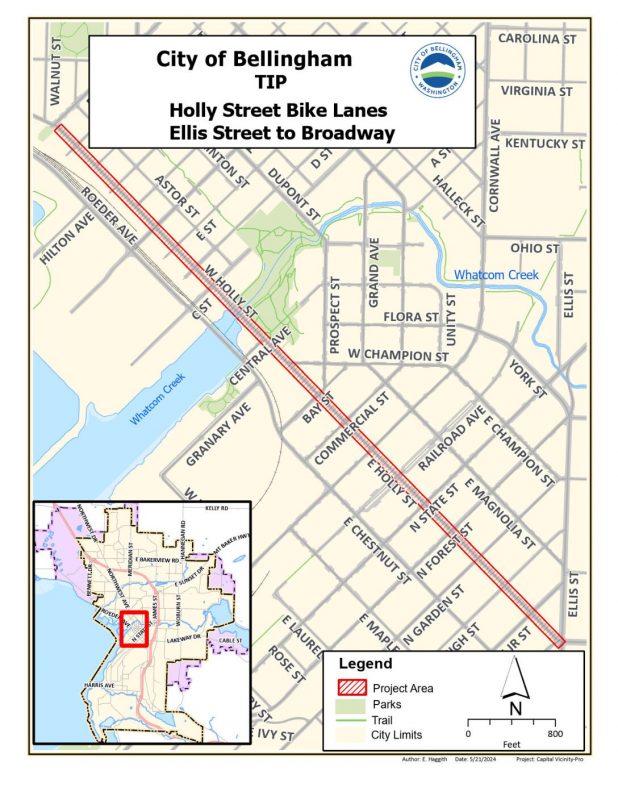
The 2024 Bicycle Master Plan prioritizes Holly Street from Ellis Street to Broadway as a key corridor for bicycle improvements. The Bicycle Master Plan is guided by a data-driven network analysis and extensive public and stakeholder input. This project aims to close a critical gap in the City’s bike network by establishing cycling infrastructure along the entire Holly Street corridor. Additionally, it presents an opportunity to enhance pedestrian safety and comfort in the downtown area. This will address needs identified in the City’s Local Road Safety Plan. The project also aligns with Bellingham’s Complete Networks Ordinance, which prioritizes the safety and accessibility of the most vulnerable users in the city’s multimodal transportation system.
More Information
This project is included in the City’s 2026-2031 Transportation Improvement Program.
- Project design: began summer 2025
- Contractor: MIG selected for planning and design services
- Expected construction start date: winter 2027
- Expected construction end date: summer 2027
From August through September 2025, the City gathered community input on corridor priorities through an Engage Bellingham campaign. This feedback is helping shape the final plan for Holly Street, from Ellis to Broadway. You can review community questions and answers on the Engage Bellingham Final Design – Holly Street Corridor page. The City will announce additional opportunities for public input as the project design moves forward.
We’ve secured partial funding for this project, including $1.5 million in Economic Development Initiative grant funds. The City is pursuing additional grant applications to support anticipated project expenses.
Transportation Data
An engineering evaluation of existing roadway conditions in 2016 identified a high level of traffic stress for bicyclists along this stretch of Holly Street. This indicates a functional gap in the active transportation network that poses systemic safety risks, likely deterring all but the most confident riders. Despite these challenges, data shows that bicyclists make up approximately 3.6% of total traffic during the afternoon peak hour, underscoring the importance of this corridor in the city’s bike network.
City’s Commitment to Improving Multimodal Transportation Options
For more than 15 years, downtown Bellingham has steadily expanded active transportation facilities, adding bike lanes to most downtown arterials. However, Holly Street remained a notable exception until the 2024 bike lane pilot project began addressing this gap.
2024 Holly Street Bike Lane Pilot Project
The 2024 Holly Street Bike Lane Pilot Project reaffirmed Holly Street’s significance as downtown Bellingham’s busiest bike corridor, with ridership surpassing the next highest route by more than 44% between June and September 2024. Findings from the Pilot highlight the need for improved bicycle facilities along this corridor to support the city’s overarching multimodal transportation goals.
Community Input on Pilot
Through the pilot, we conducted rigorous data collection and analysis to provide objective evidence of the project’s impact on pedestrians, vehicles, and transit. Extensive community engagement also helped shape the pilot’s direction, generating more than 1,300 comments and 1,171 survey responses through EngageBellingham.
Public feedback on the pilot project reflected a range of perspectives, with significant concerns regarding safety, traffic flow, and overall design. Data analysis reflected these concerns, particularly visibility challenges at intersections with the parking-protected bike lane, where a higher frequency of right-hook conflicts occurred. This feedback, combined with data findings, informed several project modifications, including the addition of bend-ins at intersections and street re-channelization. In summer 2025, the City will replace parking-protected bike lanes with traditional buffered bike lanes, similar to those already found throughout Bellingham. These iterative adjustments demonstrate the importance of both community engagement and a data-driven approach in refining project design. You can find more information about the pilot project on the Holly Street Bike Lane Pilot Project webpage.
Contact
General project questions: AskPW@cob.org
Media inquiries: pwmedia@cob.org
Project Manager
Freeman “Fritz” Anthony, Project Engineer
Email: fanthony@cob.org
