Project Overview
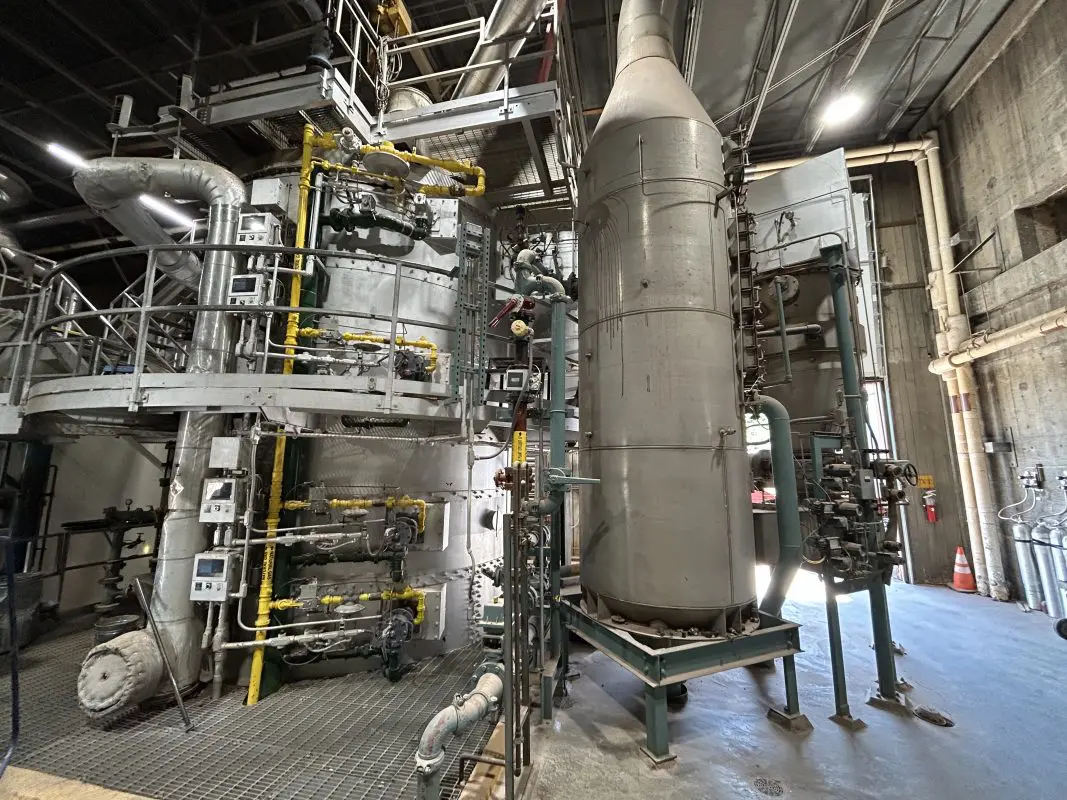
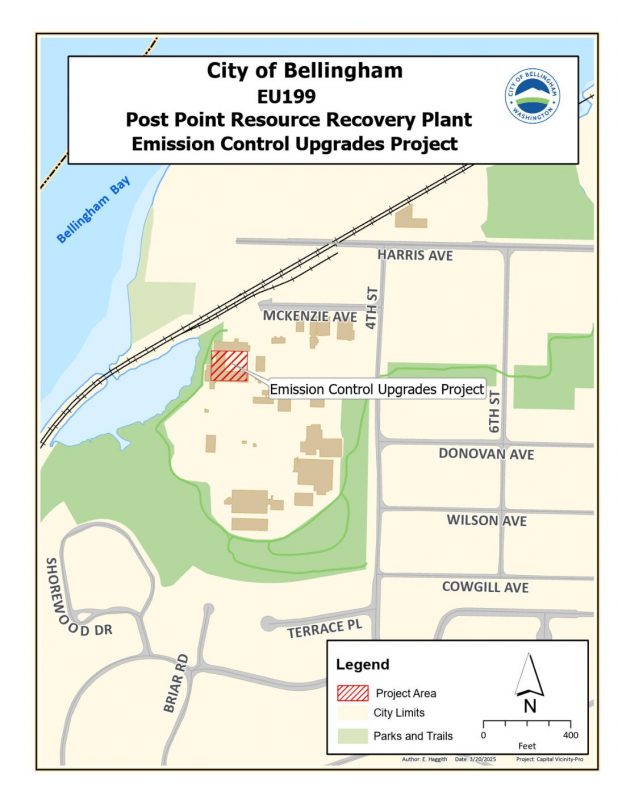
The Emission Control Upgrades Project (EU199) aims to enhance air quality controls for the incinerators at the Post Point Wastewater Treatment Plant. This facility provides wastewater treatment services for the City of Bellingham through a series of advanced processes. Here, we treat and disinfect the liquid effluent before discharging it into Bellingham Bay. We also separate and dewater the solids collected from the treatment process. We then combust the resulting sewage sludge using two Sewage Sludge Incinerators (SSI). This process further reduces the solids mass and destroys harmful pathogens. Ash resulting from the incineration process is transported to a landfill. The incineration process also generates exhaust gases. We utilize an afterburner, a venturi, a tray scrubber, and a Wet Electrostatic Precipitator (WESP) to remove pollutants from emissions before releasing them through stack units at Post Point.
This project will implement advanced air pollution control technology to enhance the plant’s exhaust gas treatment systems. This upgrade is a measure to ensure the SSIs meet evolving and increasingly stringent air quality regulations. By investing in these advanced emission control systems, the City of Bellingham reinforces its commitment to environmental stewardship. These upgrades will improve air quality and ensure the continued safe and compliant operation of the wastewater treatment facility. Furthermore, this project will extend the use of the current solids handling infrastructure while we investigate alternative long-term options.
Regulatory Background and Settlement Agreement
In March 2024, the Northwest Clean Air Agency (NWCAA) issued a Notice of Violation (NOV) related to the existing incinerators at the Post Point Wastewater Treatment Plant. While the City continued advancing maintenance and planning for major air-quality upgrades, both agencies worked together to review the issues and determine a clear, forward-looking path.
On November 18, 2025, the City and NWCAA finalized a settlement agreement that fully resolves the Notice of Violation based on the City’s commitments in the settlement. The agreement does not include any finding that the City committed a violation. Instead, it confirms the steps and schedule for the Emission Control Upgrades Project already underway.
These upgrades will replace aging pollution control equipment, bring the incinerators up to more stringent federal standards, and improve air quality at Post Point.
Under the settlement agreement, the City will:
- Use continuous emissions monitoring for carbon monoxide, as required under a 2025 regulatory order.
- Maintain specified afterburner temperatures while the new systems are being designed and installed.
- Complete a series of project milestones—design, permitting, construction, and performance testing—on a defined schedule.
- Provide annual written updates to NWCAA until performance testing of the emission control upgrades for both incinerators is complete.
These requirements align with the City’s existing plan to modernize the incinerators and maintain reliable wastewater treatment while planning for long-term solids management solutions.
Project Status – Summer 2026
The City, in coordination with our selected consultant, Brown and Caldwell, has completed an analysis of options for Emission Control Upgrades at the Post Point facility. We’ve chosen an approach that balances environmental, cost, and regulatory priorities to ensure safe, compliant operations. The project is in the design phase, and we have selected Walsh Construction Company LLC to provide General Contractor/Construction Manager (GC/CM) services. Walsh was authorized to be contracted as the General Contractor and Construction Manager at the August 10, 2026 city council meeting. The initial phase of this GC/CM contract will include preconstruction services and support the project design.
Project Updates and Annual Reporting
The settlement agreement requires the City to provide NWCAA with annual progress updates as the Emission Control Upgrades Project moves forward. The City submitted the first annual written update and Basis of Design Report for the Emissions Control Upgrades Project on June 12, 2026
More Information
- Project design: Started in early 2024
- Contractor: Brown and Caldwell selected for planning, design and permitting services
- Expected construction start date: 2027
- Expected construction end date: 2030
The Emission Control Upgrades Project will move through several phases over the next few years. The work includes detailed design, permitting, construction, and required testing before the upgraded air-quality control systems become fully operational.
Planning and Design Phase
- Develop the Basis of Design for the upgraded emissions control system
- Advance engineering design for new air-pollution control equipment
- Prepare and submit required permit applications, including a Notice of Construction to NWCAA
Procurement and Pre-Construction
- Select and contract with a general contractor/construction manager (GC/CM)
- Prepare the site and coordinate equipment procurement
Construction Phase
- Install new air-pollution control equipment
- Integrate continuous monitoring systems and updated controls
- Conduct commissioning and system startup
Performance Testing and Final Compliance
- Complete required performance testing on the new emission control systems for each incinerator once construction is finished
- Provide annual updates to NWCAA until both units have completed testing
Because large infrastructure projects involve coordination with regulators, equipment manufacturers, specialty contractors, and supply chains, the timeline includes built-in flexibility to account for unexpected conditions.
This webpage will be updated as the project advances.
Prior to 2022, the City had been engaged in a sustained, multi-year effort to study and plan for the replacement of the plant’s SSI units with anaerobic digestors, as an alternative solids-handling system. Anaerobic digesters rely on bacteria to break down sewage sludge into a compost-like byproduct known as biosolids. Biosolids may be sold and used as fertilizer. Anaerobic digestion also produces a renewable energy source known as biogas, which can be combusted to generate electricity or processed into renewable natural gas.
Unfortunately, anaerobic digestion does not break down certain toxic contaminants which may be present in wastewater, including Contaminants of Emerging Concern like plastics, fire retardants, PFAS (Per- and PolyFluoroAlkyl substances) and PCBs (PolyChlorinated Biphenyls). Throughout the planning process, the City became increasingly concerned with the prospect of land applying biosolids containing Contaminants of Emerging Concern.
The cost of the anaerobic digestion project was another significant concern, with estimates ranging from $200 million to $1 billion.
In September 2022, the City made the decision to stop pursuing anaerobic digestion and to refocus efforts on repairing, rehabilitating, and upgrading the plant’s existing sewage sludge incinerators. This project is a direct result of those previous decisions.
Additional Resources
Wastewater Solids Management Page
Contact
General project questions: AskPW@cob.org
Media inquiries: Email pwmedia@cob.org
Project Engineer
Stephen Day, Plants Engineer
Phone: (360) 778-7944
Email: smday@cob.org
