Wastewater Solids Management

The City of Bellingham is responsible for managing the solids generated through wastewater treatment in a way that protects public health, complies with environmental regulations, and is sustainable over the long term. Solids management is complex and involves careful consideration of treatment effectiveness, environmental impacts, regulatory requirements, cost, and operational reliability.

This page explains how we currently manage solids at the Post Point Wastewater Treatment Plant, why we are investing in continuing our incineration-based approach, and a summary of the alternatives that have been considered.

Read a message from our Public Works Director to learn more about the City’s current investments at Post Point and how we’re planning responsibly for the future of wastewater solids management.
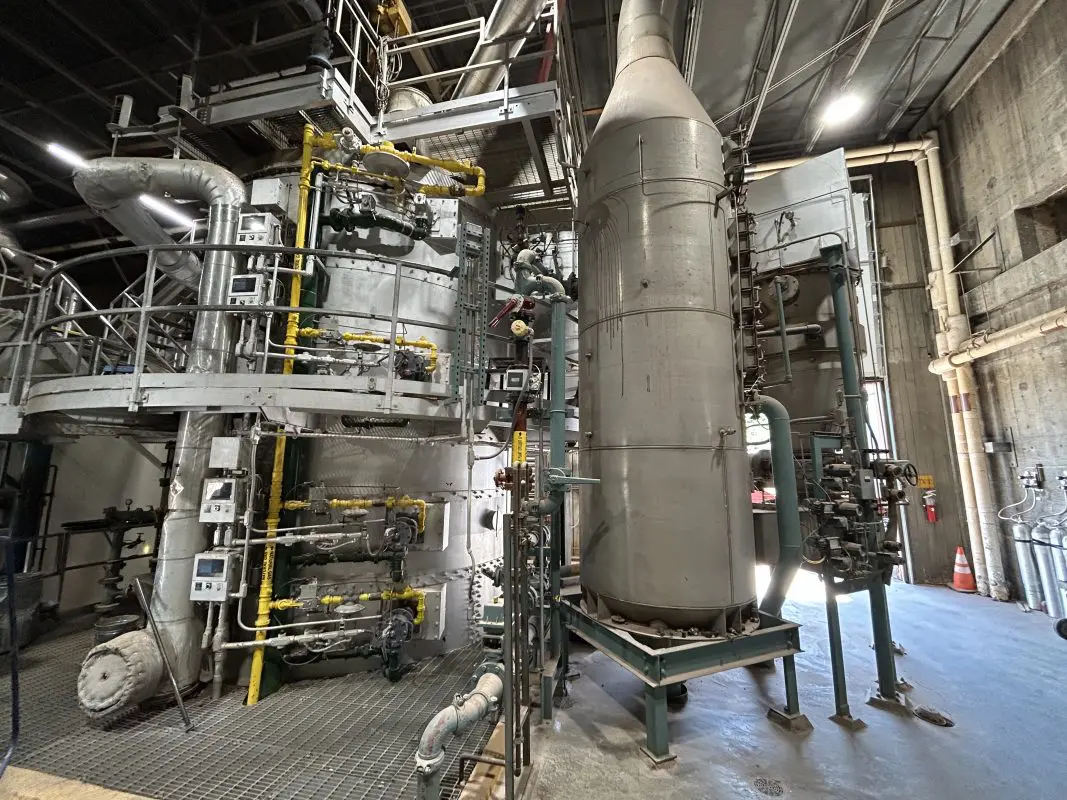
Sewage Sludge Incinerator 1 and Scrubber at Post Point Wastewater Treatment Plant

Current Treatment Method: Incineration at Post Point

Bellingham has managed wastewater solids through incineration since 1973. The system thermally treats solids, significantly reducing their volume and destroying pathogens and many organic contaminants.

Dewatered wastewater solids are fed into a high-temperature multiple-hearth incinerator. In this system, solids pass through a series of stacked hearths where they are dried, combusted, and reduced to inert ash. The combustion process is carefully controlled and continuously monitored to ensure consistent performance and compliance with air quality regulations.

The resulting ash is less than 10% of the original solids volume. This ash is managed as solid waste and transported to a landfill permitted to receive it.

The City operates under federal air emissions regulations administered regionally by the Northwest Clean Air Agency (NWCAA). NWCAA provides independent regulatory oversight and holds the City accountable through ongoing inspections, data reviews, and permit compliance requirements. We work closely with NWCAA to ensure we stay in compliance and address evolving environmental requirement

The City is investing approximately $40 million to further improve air emission controls at Post Point. This project is currently in the design phase, with construction expected from late 2026 to 2028. These upgrades will help us meet anticipated future regulations and further reduce emissions, reinforcing our commitment to long-term air quality and environmental protection. 

All wastewater solids treatment processes have benefits and limitations. Some benefits of incineration include:

  • Volume reduction: More than 90% mass reduction, resulting in significantly less material requiring disposal.
  • Pathogen destruction: High temperatures effectively eliminate biological contaminants.
  • Minimization of PFAS and other contaminants: While incineration does not guarantee the complete destruction of all PFAS and other contaminants, it significantly reduces the risk of their environmental release by breaking down many persistent or emerging compounds under high-temperature conditions.
  • On-site treatment: Reduces the need for long-haul transportation and minimizes odor impacts on neighborhoods.
  • Regulatory predictability: Long-established permitting and oversight frameworks are in place.

Incineration also has limitations, which include:

  • Energy demands: Thermal treatment is energy-intensive, requiring substantial amounts of energy for effective operation, which can lead to high operational costs.
  • Capital and maintenance costs: Incineration systems necessitate significant upfront investment for installation and ongoing costs for maintenance and upgrades over time to ensure efficiency and compliance with regulations.
  • Ash disposal: While ash volume is small, it still requires transport and landfill space.
  • Community concerns about health and environmental impacts: Incineration technologies are subject to careful regulation and oversight, but some community members may still have concerns about potential impacts on air quality and health. To address these concerns, the City prioritizes transparency, enforces strict emissions standards, and conducts ongoing environmental monitoring to ensure safe and responsible operation.

A note about PFAS: While research on the fate and transformation of PFAS during thermal treatment is ongoing, high-temperature incineration—when operated under optimal conditions with sufficient temperature, residence time, and oxygen—is currently considered one of the more effective available methods for reducing the environmental release of persistent contaminants such as PFAS. However, concerns remain about the potential formation of incomplete combustion byproducts, and the overall efficacy of incineration varies depending on the specific PFAS compounds, incinerator design, and operating parameters.

Evaluating Alternatives to Incineration

The City continually assesses alternative methods for managing wastewater solids, aiming to find the most sustainable, reliable, and cost-effective solution for Bellingham. Below are alternatives that have been considered, along with the key challenges they present at this time. 

The City previously worked for many years on a project to transition away from incineration in favor of anaerobic digestion and biosolids land application. In this approach, solids would be broken down by microbes in oxygen-free digesters, producing a methane-rich biogas for potential energy recovery. The resulting stabilized biosolids would then be transported and applied to land as a soil amendment.

In September 2022, the City made the decision to stop pursuing anaerobic digestion and to refocus efforts on repairing, rehabilitating, and upgrading the plant’s existing sewage sludge incinerators. This decision was based on several key factors:

  • Community concerns: After significant public engagement, concerns were raised about PFAS (per- and polyfluoroalkyl substances) and other contaminants potentially entering the environment through land application
  • Infrastructure requirements: The shift would have required new digestion tanks, dewatering systems, biosolids storage facilities, and long-haul transportation systems.
  • Cost: The project was initially estimated at $220 million and rising, with long-term operational costs significantly higher than incineration.
  • Regulatory uncertainty: Changing state and federal policies related to biosolids land application added complexity to long-term planning.

This option involves hauling solids to a landfill for disposal. The City studied this alternative and concluded that, while landfilling is used in some areas and could be considered as a short-term emergency measure, it is not a viable long-term solution for Bellingham for several reasons:

  • No permitted landfills available: Currently, there are no local landfills permitted to accept the type of undigested sludge produced at Post Point. Our dewatered solids would require transport distances of over 300 miles (one-way) for disposal in the nearest regional landfills capable of taking this material.
  • Environmental risks: Many landfills are increasingly restricting sewage sludge due to its high liquid and organic content and the presence of potential contaminants. 
  • Regulatory conflicts: Washington State actively promotes diverting organic waste from landfills as part of broader sustainability goals. 
  • Odor and transport concerns: Without digestion, our solids have a high potential for odor during storage and transport. 
  • Uncertain long-term viability: Landfill access, transportation costs, and regulatory conditions can change over time, making this an unstable long-term strategy. 
  • Concentrates future pollution: Landfilling wastewater solids merely stores contaminants, including PFAS, without destroying them. This concentration within landfills creates a future source of potential environmental contamination and does not eliminate the problem.

In short, landfilling would not solve the environmental or logistical challenges of solids management – and could introduce new ones. Learn more in our Post Point Solids Handling decision summary.

These are newer thermal processing technologies that use controlled heating in low-oxygen or pressurized environments at temperatures higher than incinerators to convert solids into energy, synthetic gas, or biochar.

Why these aren’t feasible today:

  • Limited operational track record: These systems are still in the pilot or demonstration phase for municipal solids. Few, if any, are operating reliably in North America at a scale that would be needed in Bellingham.
  • Complex inputs: Technologies like gasification require highly consistent feedstock, and wastewater solids are notoriously variable in moisture and composition, therefore may require extensive preprocessing.
  • High capital costs: These systems often have startup costs equal to or greater than incineration, with greater technical complexity.
  • Uncertain emissions profiles: While marketed as clean alternatives, independent emissions data is limited. Some technologies still release combustion byproducts or concentrate contaminants into char or condensate, which then require disposal.
  • Technology risk: Adopting an emerging system would introduce uncertainty around long-term reliability, regulatory acceptance, and operations staffing.

The City continues to monitor advances in these technologies and may consider them as they become more mature and better understood.

Our Commitment Moving Forward 

The City remains committed to a long-term, sustainable, and community-responsive approach to managing wastewater solids. Our current focus is on modernizing and improving our existing incineration system to ensure continued public health protection, air quality compliance, and financial responsibility. The decision to reinvest in incineration is grounded in a decade of analysis, regulatory compliance, public engagement, and operational experience. Incineration remains the most practical and environmentally protective solution available today for our specific conditions.

We will continue to evaluate new technologies and alternative strategies as they evolve and keep the community informed as we plan for the future.

Resources