The Bellingham Plan: Improvements Funding

This page provides additional information related to topics covered by the Bellingham Plan. 

Housing cost vary based on a variety of factors including land, materials, labor, builder-incurred overhead costs, profit, and city fees. For building a typical single-family detached home in Bellingham city fees comprise about 4% of final housing cost. The below graphic illustrates the cost to build a typical single-family detached home.
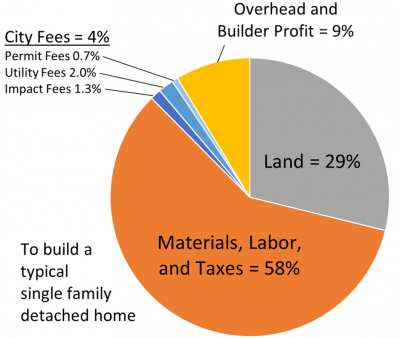

Pie chart showing the typical percentage of costs to build a single family detached home.  City fees (permit, utility and impact fees) account for 4% of the cost. Materials and Labor are 58%. Land is 29%. Overhead and profit account for 9%

There are 3 main types of City development fees:

These fees cover the costs of reviewing construction plans and inspecting work on-site to ensure drainage, foundations, framing, wiring, plumbing, and other elements meet the fire and structural safety standards of the residential building code. Adherence to these standards provides for the safety of residents and the community.

These fees help offset expansion of citywide water, sewer, and storm utility systems (system development charges), and the cost to add a water meter and connect utility lines directly from the street to a new home.

New development brings new residents who use our roads, parks, and schools. Cities adopt impact fees to ensure new development helps pay its “fair share” as these systems are expanded to accommodate more people. Bellingham charges impact fees for traffic, parks, and schools.

  • Traffic Impact Fees help offset the cost of new roads, sidewalks, bike lanes, and traffic signals necessary to accommodate vehicle trips associated with new development.
  • Park Impact Fees help offset the cost of new parks, trails, and recreation programs.
  • School Impact Fees help offset the cost (to school districts) of additional classroom space, staff, and programs.