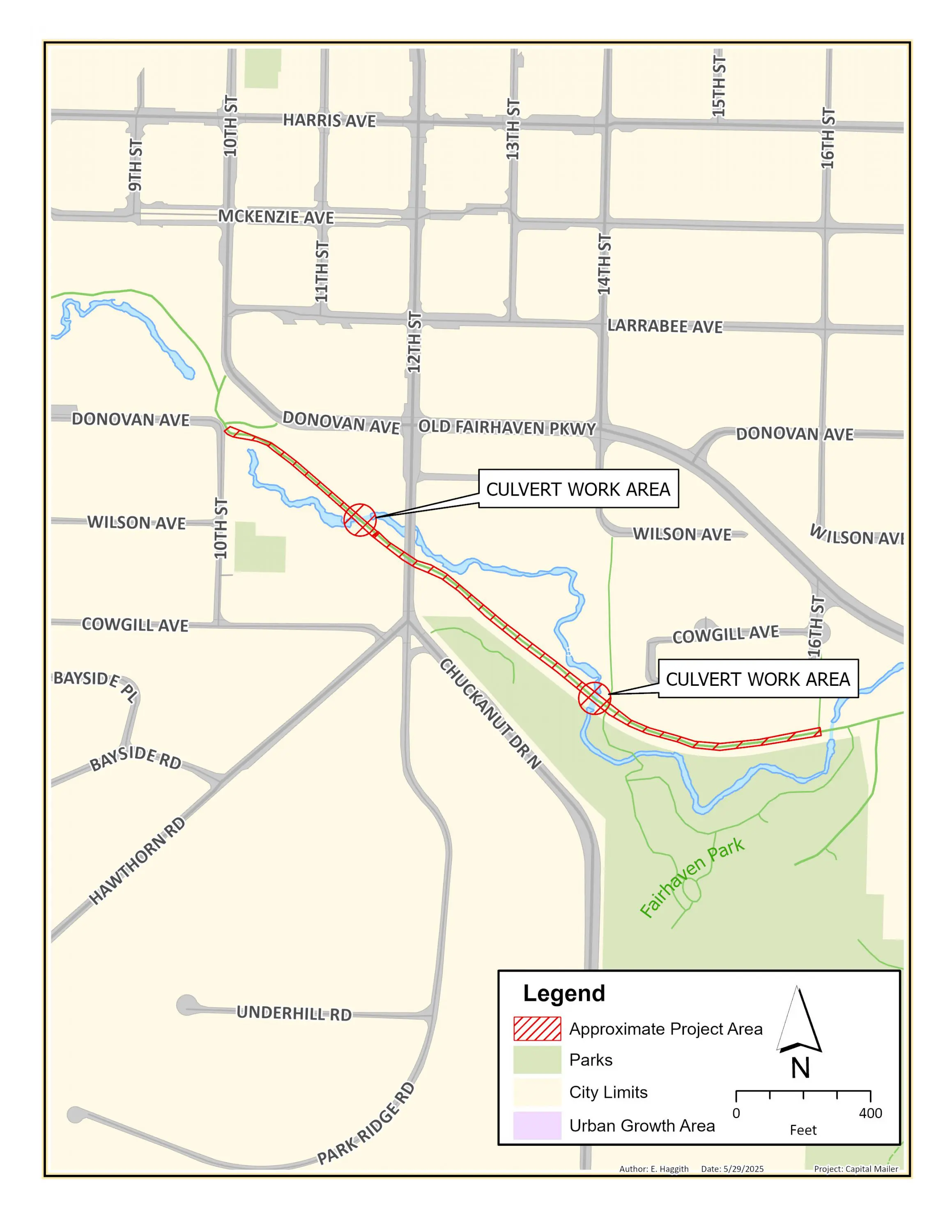
The Padden Creek at 12th Street and 14th Street Fish Passage Improvements Project is part of a well-coordinated, strategic approach to fish barrier removal. This project removed two City-owned fish passage barriers located where the Interurban Trail crosses Padden Creek. Removing these barriers make the crossings 100% passable for fish, including Chinook, coho, and chum salmon, steelhead and sea-run cutthroat trout, and resident fish species. These barriers were ranked as high priority for improvement in the City’s Fish Barrier Prioritization.
Project Status: Complete (2026)
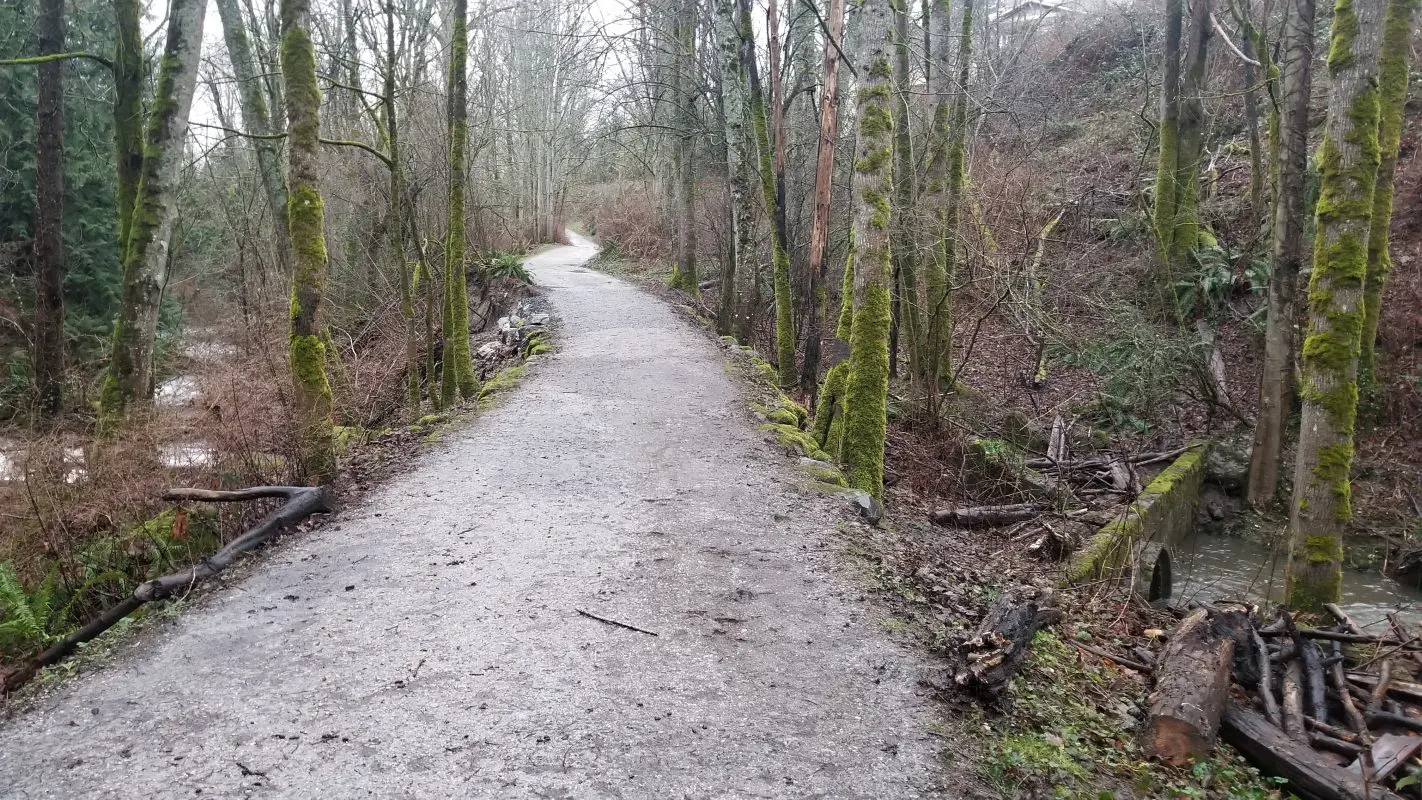
This project is complete and the section of the Interurban Trail that was closed during construction is open. Crews resurfaced the trail, installed new railing, added mulch and topsoil, and planted native vegetation. Young plants are protected with fencing to prevent deer browsing.
There will be a temporary construction fence around the former construction staging area at 16th Street to allow grass to re-grow.
Please help protect Padden Creek and the restored area by staying on the designated path with both people and pets. Thanks to everyone for their patience and understanding during project construction!
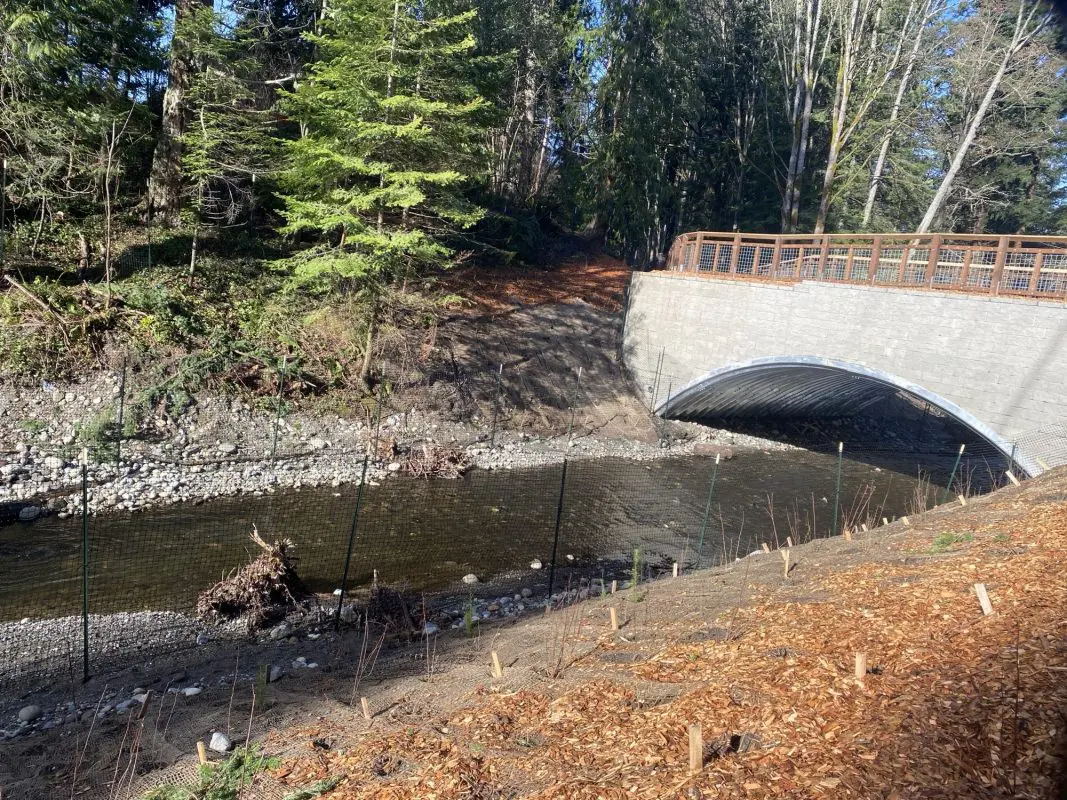
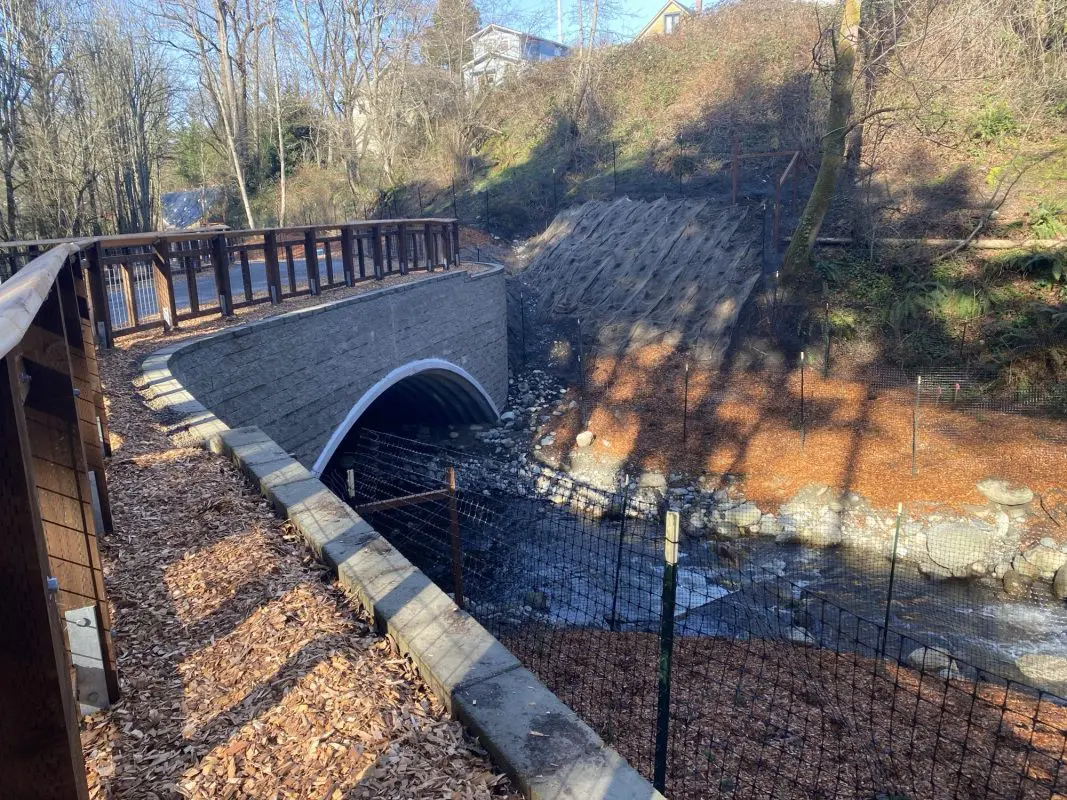
In-water work was completed in the fall and water is flowing freely under both of the new fish-friendly arch culverts. Salmon have been spotted upstream of the project area, which indicates that they are able to successfully pass under the new culverts. Large woody debris was also added to the creek to create habitat, stabilize streambanks, and manage stream flows.

Padden Creek diesel spills (August 2025)
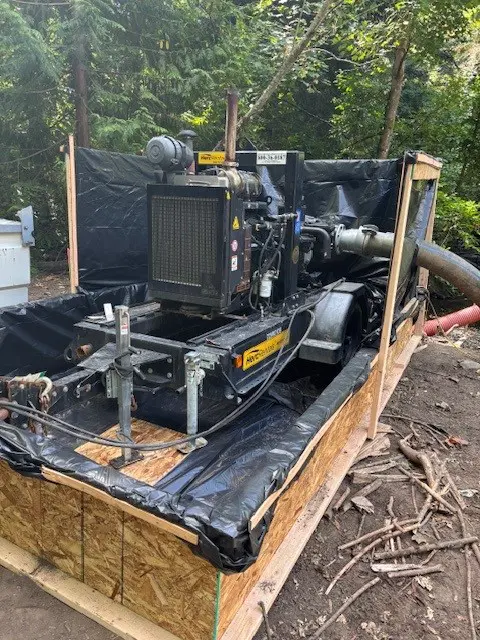
This incident involved two leaks from a faulty pump (initial confirmation August 3, second leak August 7) at the Padden Creek Fish Passage Project site. Emergency spill operations have been addressed by a Unified Command, including the Washington State Department of Ecology (lead agency), City of Bellingham, Lummi Nation, Nooksack Indian Tribe, and Faber Construction. Additional support came from Graymar Environmental Services, the contractor responsible for cleanup operations.
Shoreline Cleanup and Assessment Technique (SCAT) teams conducted a final walkthrough on August 25 and confirmed that no recoverable fuel remained. Work at the spill site has transitioned from emergency response to restoration and long-term monitoring. The Department of Ecology will conduct an investigation to determine the party/parties responsible for cleanup costs.
What happened?
The incident involved two diesel leaks from a faulty pump powering a bypass system at the 12th Street bridge construction site. The construction contractor was offsite when the spills happened. The initial release, confirmed on Sunday, August 3, caused diesel to spray beyond the secondary containment and project area, entering Padden Creek. The broken fuel line was quickly repaired. A second spill, from a fuel line break on the same pump, was discovered and reported on Thursday, August 7. On August 8, to prevent further incidents, the problematic pump was removed and replaced, enhanced secondary containment was installed at all pump locations, and the contractor implemented round-the-clock in-person site monitoring.
The Washington Department of Fish and Wildlife issued a stop work order affecting all project activities except essential bypass pumping at both the 12th and 14th Street sites. This order was lifted once the new pump was operational, secondary containment was enhanced, and impacted soils were removed.

How large was the spill?
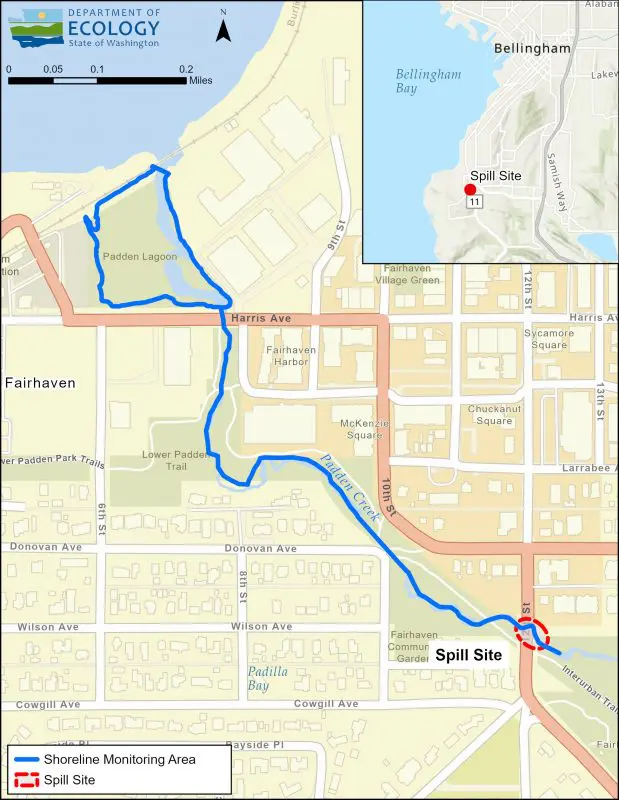
Diesel leaked from the project site starting near where the Interurban Trail intersects 12th Street and downstream for about one-third of a mile. The Department of Ecology estimates the first spill released 344 gallons of diesel and the second spill released an estimated 332 gallons. The combined total of the spills is an estimated 676 gallons. The Unified Command ensured the spill was contained and no fuel reached Bellingham Bay.
What were the emergency cleanup actions?
Sediment sampling and shoreline cleanup assessment surveys helped guide response actions. During the emergency response phase, crews:
- Removed and replaced the faulty pump, added enhanced secondary containment around all pumps, and implemented round-the-clock on-site pump monitoring.
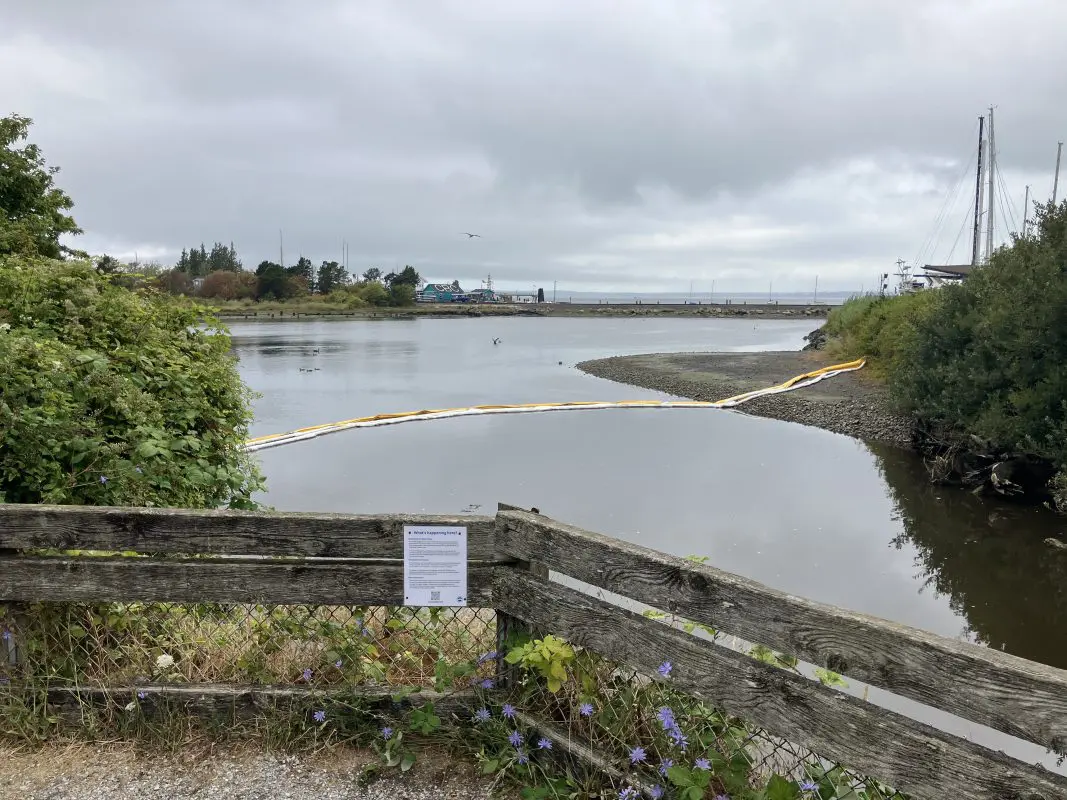
- Deployed many sets of boom (floating pieces of plastic that act as barriers to contain spills) near the mouth of Padden Creek and upstream to collect and contain any potential downstream travel of diesel from the spill site
- Placed sorbents (pads that help absorb oil) in the creek that were regularly changed out.
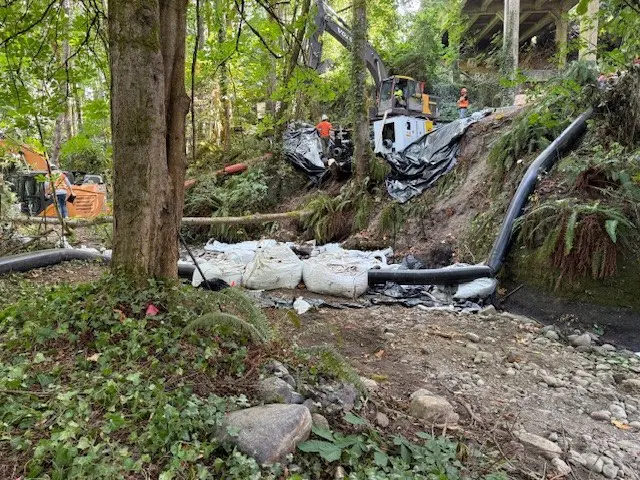
- Removed contaminated soil, reinforced coffer dams, and installed additional pumps to control creek flow during heavy rain.
- Flushed areas along the creek bed with water and used a temporary dam and oil absorbent boom to catch any diesel that was mobilized by flushing.
What are the environmental impacts?
Fish and Wildlife
Focus Wildlife was hired as a wildlife responder to monitor for injured wildlife and deter wildlife from entering the affected area. The Washington Department of Fish and Wildlife was also part of the spill response. Unfortunately, wildlife responders recovered the carcasses of two deceased cutthroat trout, three coho salmon, and one crayfish in the creek and their deaths are likely related to the spill. While more observations of deceased fish have been reported, trained responders, including Focus Wildlife, were able to collect and confirm the cause of death for these five fish and one crayfish. No fish or wildlife impacts were observed after August 10.
To minimize stress and injury to oiled wildlife, the public must not attempt to capture any oiled wildlife. This can endanger the safety of both the public and the animals. Instead, report any sightings of potentially oiled animals by calling 1-800-22-BIRDS (1-800-222-4737).
Soil and Vegetation
Previous sampling and construction work indicate that a shallow topsoil layer lies above a clay layer that has helped to limit fuel from seeping further down. Additional sampling was done to determine the extent of contamination. A total of 23 truckloads of material (324.1 tons) were removed for disposal, which will be backfilled with clean material. Soil immediately adjacent to the 12th Street bridge could not be fully excavated without risking the bridge’s structural integrity. Soil removal is not expected to affect the stability of the surrounding areas.
One impacted tree was also removed for safety. All vegetated areas disturbed by spill operations or the fish passage project construction will be re-planted.
What does the transition to long-term restoration look like?
In late August 2025, Unified Command confirmed that all emergency response objectives were achieved to the extent possible. Recovery actions were completed to a standard that establishes the foundation for long-term recovery. Long-term restoration and monitoring are now being coordinated by Ecology’s Toxic Cleanup Program (TCP) and Natural Resource Damage Assessment (NRDA) trustees. TCP will evaluate where further remediation is needed and manage any long-term cleanup. Tribal, state, and federal trustees will assess harm to fish, wildlife, habitat, and recreation, and determine restoration projects funded by the responsible party.
Who do I contact with questions?
Feel free to email us at AskPW@cob.org with any questions or concerns. We will continue to update this page as we learn more.
You can also send a message to liaison@ecy.wa.gov to receive email updates.
Final Unified Command Update – August 28, 2025 at 8 p.m.
Emergency response completed at Padden Creek spill site
Emergency spill response operations at Padden Creek have concluded. Shoreline assessments and cleanup were completed, with contaminated soil removed to the extent possible, the creek flushed, and protective measures installed. Work has now transitioned to restoration and long-term monitoring.
Crews removed contaminated soil wherever feasible. Soil immediately adjacent to the bridge could not be fully excavated without risking the bridge’s structural integrity. In the stream channel, additional excavation would have caused more harm to habitat than leaving residual material in place.
The Lummi Nation, Nooksack Indian Tribe, Washington Department of Ecology (Ecology), Washington Department of Fish and Wildlife, City of Bellingham, and Faber Construction have managed the response together as a Unified Command since Aug. 8. Additional support came from Graymar Environmental Services, the contractor responsible for cleanup operations.
Background
The spill originated from a malfunctioning pump on a generator at the 12th Street bridge construction site. The faulty pump released diesel into roughly one-third of a mile of Padden Creek in two separate incidents on Aug. 3 and Aug. 7, before the generator was removed and replaced. Crews deployed boom, removed contaminated soil, reinforced coffer dams, and installed additional pumps to control creek flow during heavy rain. Wildlife monitoring has been ongoing with no additional impacts observed after Aug. 10.
Over the weekend of Aug. 23-24, the Unified Command approved Faber Construction to resume stream bed backfill and restoration at the bridge site, as part of the original project underway before the spill. Shoreline Cleanup and Assessment Technique (SCAT) teams conducted a final walkthrough on Aug. 25 confirming that no recoverable fuel remained. Flushing operations were discontinued and equipment removed from the site.
Transition to Restoration
Unified Command confirmed that all emergency response objectives were achieved to the extent possible. Recovery actions were completed to a standard that establishes the foundation for long-term recovery.
Restoration and monitoring are now being coordinated by Ecology’s Toxics Cleanup Program (TCP) and Natural Resource Damage Assessment (NRDA) trustees. TCP will evaluate whether further remediation is needed and manage any long-term cleanup. Tribal, state, and federal trustees will assess harm to fish, wildlife, habitat, and recreation, and determine restoration projects funded by the responsible party.
Incident Response Summary
- Fuel released: Approximately 676 gallons of diesel in two releases
- Response actions: Deployed containment boom and sorbents; ensured and reinforced secondary containment at the pump to prevent future spills; 23 truckloads of contaminated soil removed for disposal, totaling 324.1 tons; flushing operations and sediment sampling conducted; streambank reinforced; and one impacted tree removed for safety
- Wildlife impacts: Five fish and one crayfish confirmed killed
- Public health: No fuel reached Bellingham Bay, and there were no drinking water impacts
- Community impacts: The 10th Street trail closure has reopened, with some equipment still onsite
More information
- Find information about Natural Resource Damage Assessment (NRDA)
- Find information about the Toxics Cleanup Program (TCP)
- Report injured wildlife: 1-800-22-BIRDS (1-800-222-4737)
- Questions or concerns: Liaison@ecy.wa.gov
Update – August 25, 2025 at 6:30 p.m.
Here are the latest updates on the response to the Padden Creek diesel spill.
Over the weekend, the Unified Command approved Faber Construction to resume streambed backfill and restoration at the 12th Street bridge spill site, as part of their original project that was underway before the spill.
Today, Shoreline Cleanup and Assessment Technique (SCAT) teams are completing a final walkthrough. If the walkthrough confirms no recoverable fuel remains, flushing operations will be discontinued and equipment will be removed from the site. Sorbent materials have not been collecting any product in recent days and sampling results have consistently come back below detection levels.
Unified Command continues to work toward confirming end points for the emergency response. These objectives ensure that recovery actions are completed to a standard that protects the creek and establishes the groundwork for long-term restoration. After the emergency response ends, restoration planning will be coordinated by Ecology’s Toxics Cleanup Program (TCP) and Natural Resource Damage Assessment (NRDA) trustees as part of long-term restoration planning.
- To receive these updates via email, please reach out to Liaison@ECY.WA.GOV.
- Media inquiries: contact Jessica Kulaas, jessica.kulaas@ecy.wa.gov.
Update – August 23, 2025 at 4 p.m.
Cleanup work at Padden Creek made strong progress on Thursday, with crews removing 10 truckloads of contaminated soil. In total, 23 truckloads have been hauled away for disposal.
Yesterday, Unified Command decided to stop excavation at the immediate spill site, in coordination with WSDOT, to avoid impacts to the 12th Street bridge pilings. Our sampling indicated that some diesel remains in this area. When emergency response operations end, further remediation will transition to Ecology’s Toxics Cleanup Program (TCP), which will oversee long-term cleanup efforts. To learn more about TCP, visit: Toxics Cleanup – Washington State Department of Ecology.
Flushing operations are continuing downstream of the immediate spill site. Sediment sampling and shoreline cleanup assessment surveys continue to guide response actions.
No new wildlife impacts have been observed. Trail closures at 10th Street over Padden Creek are now open. Some equipment may remain in place, so please use caution when passing through.
- To receive these updates via email, please reach out to Liaison@ECY.WA.GOV.
- To report oiled or injured wildlife, call 1-800-22-BIRDS (1-800-222-4737). Do not attempt to capture any oiled wildlife.
- Media inquiries: contact Jessica Kulaas, jessica.kulaas@ecy.wa.gov.
Update – August 20, 2025 at 7:30 p.m.
Good evening – here are the latest updates on the response to the Padden Creek diesel spill.
Crews removed four truckloads of contaminated material yesterday, totaling roughly 80-85 tons, as part of ongoing cleanup efforts. Work ramped up today with more trucks on site, allowing excavation to continue at the spill area east of the 12th Street bridge. A total of 13 trucks of material have been removed since the response began.
Assessment teams collected soil samples along Padden Creek from the spill site to the confluence with Bellingham Bay at Padden Lagoon. Results from these tests will help determine when cleanup objectives are met and guide decisions about extending excavation work. Excavation operations will continue Thursday, 8/21.
Response crews are continuing to flush areas along the creek bed with water and are using a temporary dam and oil absorbent boom to catch any diesel that is mobilized by flushing.
General information
The Unified Command consists of the Washington State Department of Ecology, the City of Bellingham, Lummi Nation, Nooksack Indian Tribe, and Faber Construction.
- To receive these updates via email, please reach out to Liaison@ECY.WA.GOV.
- To report oiled or injured wildlife, call 1-800-22-BIRDS (1-800-222-4737). Do not attempt to capture any oiled wildlife.
- Media inquiries: contact Jessica Kulaas, jessica.kulaas@ecy.wa.gov.
Update – August 18, 2025 at 5 p.m.
Crews have started removing contaminated soil. There will be increased activity at the spill site during this phase of the response. Crews are using excavators to remove soil and load it into trucks. The trucks will take the contaminated soil directly to a disposal facility. Sampling results will determine the extent of remediation. Initial work is centered at the 12th Street spill site and may extend near the fish ladder at 10th Street. Any soil removed will be replaced with clean fill.
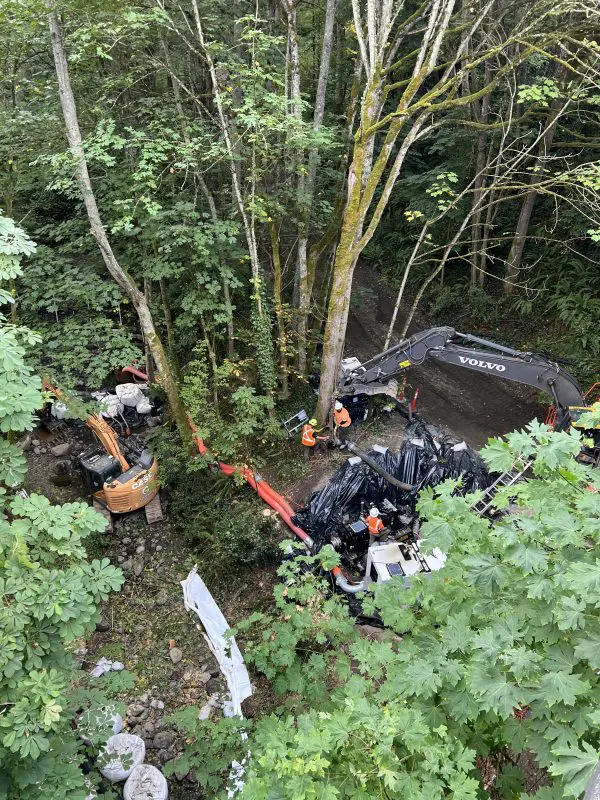
In preparation for last week’s heavy rain, crews reinforced coffer dams, added pumps, and installed additional protection. However, the amount of rainfall exceeded capacity, and Padden Creek returned to its main channel for several hours. By early Saturday, crews regained control of the water flow and reestablished diversion. Sampling is underway to determine the extent of contamination.
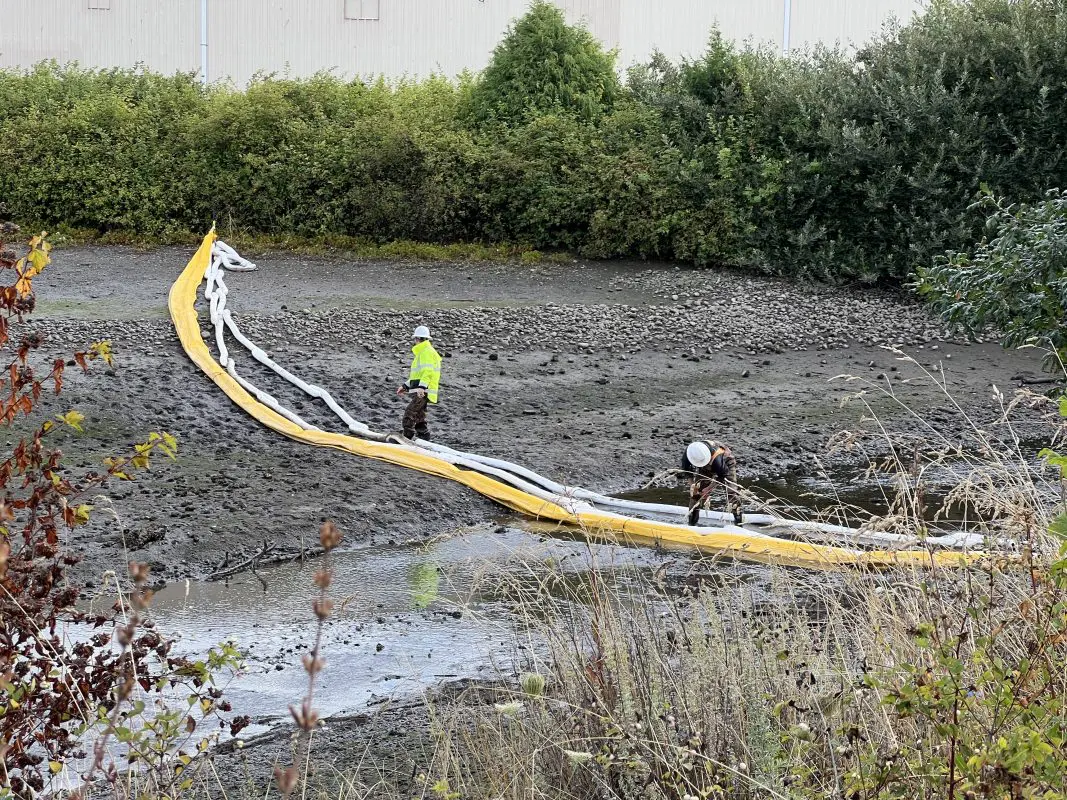
Hard boom and sorbent materials remain in place along Padden Creek to Bellingham Bay. Wildlife teams continue active monitoring, and no additional impacted wildlife has been observed since August 10.
- To receive these updates via email, please reach out to Liaison@ecy.wa.gov.
- Direct media inquiries to Jessica Kulaas, jessica.kulaas@ecy.wa.gov.
Update – August 15, 2025 at 6 p.m.
The Unified Command leading the response to the diesel spill in Padden Creek has the following updates on the progress of cleanup efforts:
- Unified Command placed temporary berms called coffer dams to capture rainwater in the spill area that would be pumped into a holding tank. During the rain event Thursday night, there was a pump malfunction with a new pump brought in for this operation. Overnight crews caught the problem right away, but not before the elevated creek level from the rain overtopped the berms. Any potentially new contamination is believed to be confined in the existing construction footprint. We will be doing additional sampling downstream to determine the extent of contamination.
- During preliminary excavation of contaminated soil around the spill site, responders identified a tree whose root system was heavily impacted by diesel. It was determined that the tree must be removed to continue excavation of contaminated soil. The response began removing the tree today.
- Locals living along Padden Creek near the response area may hear construction noise from dewatering pumps during the current rain event. Overnight noise will go back to normal once the rain has stopped and the creek level subsides. We acknowledge the impact on those living nearby and appreciate their patience as we work to clean up the spill.
General information
The Unified Command consists of the Washington State Department of Ecology, the City of Bellingham, Lummi Nation, Nooksack Indian Tribe, and Faber Construction.
- To receive these updates via email, please reach out to Liaison@ECY.WA.GOV.
- To report oiled or injured wildlife, call 1-800-22-BIRDS (1-800-222-4737). Do not attempt to capture any oiled wildlife.
- Media inquiries: contact Scarlet Tang/Ecology, scarlet.tang@ecy.wa.gov, 206-920-2600
- Below is an image illustrating the response area and downstream portion of Padden Creek being monitored by this response
Update – August 14, 2025 at 8 a.m.
The Unified Command leading the response to the diesel spill into Padden Creek that began on Sunday, August 3, 2025, has the following updates on the progress of cleanup efforts.
- Removal of contaminated soil is expected to begin this week, as weather conditions permit. Previous sampling and construction work indicate that a shallow topsoil layer lies above a clay layer that has helped to limit fuel from seeping further down.
- We have been sampling to determine the extent of contamination. Initial soil removal will focus on the spill site at 12th Street and, depending on sampling results, possibly near the top of the fish ladder at 10th Street. Any soil that is removed will be backfilled.
- We do not anticipate removing any large amounts of soil further downstream.
- Soil removal is not expected to affect the stability of the surrounding areas.
- We have received questions from neighbors about whether trail access between the two segments of 10th St over Padden Creek could be opened, to allow for a pedestrian connection between the neighborhood and the Fairhaven commercial core. Unfortunately, that trail closure is necessary for heavy equipment and cleanup crew access and will remain in effect for safety reasons. Please do not move the trail closure signs.
- Volunteers are not needed at this time. If you would like to register as an oil spill volunteer to be called out if the need ever arises, please register at oilspills101.wa.gov/volunteer-registration.
- Please do not visit any impacted areas unless you are a part of the official response and have coordinated through the response team or Tribal partners. Uncoordinated access can interfere with cleanup efforts and pose safety risks.
- Crews continue to change out sorbents (pads that help absorb oil) from the spill area and downstream to the Padden Creek estuary.
- 24-hour on-site monitoring of equipment and additional containment measures remain in place.
General information
The Unified Command consists of the Washington State Department of Ecology, the City of Bellingham, Lummi Nation, Nooksack Indian Tribe, and Faber Construction.
- To receive these updates via email, please reach out to Liaison@ECY.WA.GOV.
- To report oiled or injured wildlife, call 1-800-22-BIRDS (1-800-222-4737). Do not attempt to capture any oiled wildlife.
- Media inquiries: contact Scarlet Tang/Ecology, scarlet.tang@ecy.wa.gov, 206-920-2600
Update – August 11, 2025 at 7 p.m.
Wildlife responders recovered the carcasses of three coho salmon and one crayfish on Sunday, August 10. They surveyed the creek again today and did not find any new impacted wildlife.
To minimize stress and injury to oiled wildlife, the public must not attempt to capture any oiled wildlife. This can endanger the safety of both the public and the animals. Instead, report any sightings of potentially oiled animals by calling 1-800-22-BIRDS (1-800-222-4737).
Preparations to remove contaminated soil from the site are underway. We will keep you informed of start dates as we know more.
Crews continue to change out sorbents (pads that help absorb oil) from the spill area and downstream to the Padden Creek estuary.
24-hour on-site monitoring of equipment and additional containment measures remain in place.
- To receive these updates via email, please reach out to Liaison@ecy.wa.gov.
- Direct media inquiries to Scarlet Tang, scarlet.tang@ecy.wa.gov.
Update – August 9, 2025 at 12 p.m.
On August 8, the Department of Ecology, City of Bellingham, Lummi Nation, and Faber Construction formed a Unified Command to manage the response to the diesel spill in Padden Creek. To prevent further incidents, the problematic pump has been removed and replaced, enhanced secondary containment is installed at all pump locations, and the contractor has implemented round-the-clock site monitoring.
The Washington Department of Fish and Wildlife has issued a stop work order affecting all project activities except essential bypass pumping at both the 12th and 14th Street sites. This order is expected to be lifted once the new pump is operational, secondary containment is enhanced, and impacted soils are removed.
Cleanup crews are continuing to collect and remove diesel and monitor for impacts to wildlife. The Unified Command is working with environmental contractors to clean up the spill as quickly as possible.
We also have an update on affected wildlife. Trained wildlife responders have only been able to collect two fish whose deaths can be documented as being related to the spill. Trained responders were not able to collect other carcasses that were reported. WDFW’s oil spill response lead told us there is sometimes a discrepancy between observations and actual collected animals – sometimes people report the same carcass multiple times, sometimes the cause of death was not oil, sometimes the carcass is scavenged or washed downstream before a responder can collect it. So, the documented number of fish at this point is two.
Boom remains in several locations, and no fuel has reached Bellingham Bay.
This is all the information available at this time, but the website is being updated as new information becomes available. We’ll follow up with more information as the response evolves.
- To receive these updates via email, please reach out to Liaison@ECY.WA.GOV.
- Direct media inquires to Scarlet Tang scarlet.tang@ecy.wa.gov
- To report oiled or injured wildlife, call 1-800-22-BIRDS.
More project information
This project continues the City’s decades-long commitment to improving fish passage, recently formalized in a voluntary Memorandum of Agreement with Lummi Nation, Nooksack Indian Tribe, and Washington State Department of Fish and Wildlife. Correcting these fish barriers is a high priority based on the City’s Fish Barrier Prioritization. Improving fish passage helps address two of the most significant limiting factors to the survival of salmon and trout in the Padden Creek watershed – water temperature and habitat availability – by allowing fish to access upstream habitat that provides cold water (i.e. thermal refuge) and quality habitat for laying eggs (spawning) and rearing.
This project benefits anadromous Chinook, coho, and chum salmon, steelhead and sea-run cutthroat trout, and resident fish species. Both Chinook and steelhead are currently listed as Threatened under the Endangered Species Act. Chum salmon are the most likely to benefit from this project since Padden Creek is primarily a chum salmon stream and the existing barriers are particularly challenging for them to access because of their relatively weak swimming and jumping abilities.
The project also provides fish access to upstream habitat that has been restored by the City as part of the Padden Creek 24th to 30th Streets and the Padden Creek Daylighting restoration projects. Further upstream of this project, we are also improving fish passage at the 30th Street road crossing.
This project is one of many voluntary fish passage projects within the City of Bellingham. The project honors a Memorandum of Agreement that the City entered in 2022 with the Nooksack Indian Tribe, Lummi Nation, and the Washington Department of Fish and Wildlife as part of a shared commitment to improving fish passage.
Existing culverts
Padden Creek at 12th Street
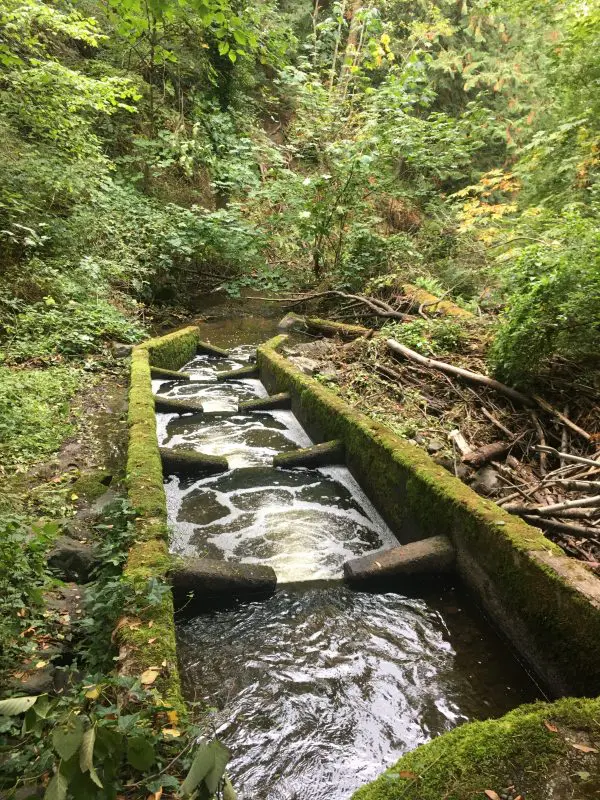
The pedestrian trail crossing on Padden Creek located just downstream of the 12th Street bridge consists of two 60-inch diameter concrete culverts which outlet to a five-step concrete fish ladder. Due to an excessive drop at the culvert outlet, lack of streambed material inside the culvert, and steep gradients associated with the fish ladder, this trail crossing is classified as a partial barrier to fish passage.
Padden Creek at 14th Street
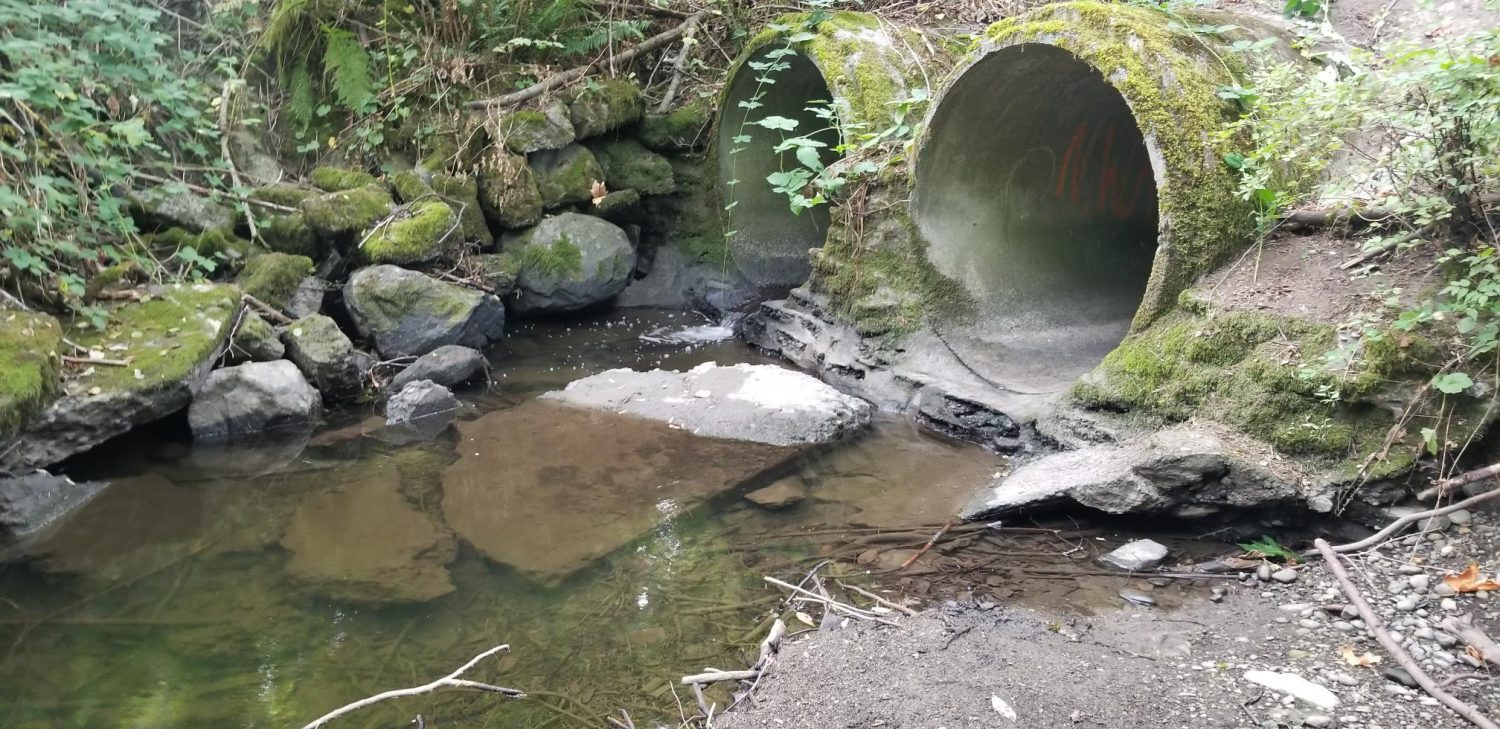
The pedestrian trail crossing on Padden Creek located downstream of the intersection of 14th Street and Wilson Avenue consists of two 60-inch diameter concrete culverts and failing log weirs. Due to high velocity and depth at the culvert outlet and lack of streambed material inside the culvert, this trail crossing is classified as a partial barrier to fish passage.
This project is funded through a Brian Abbott Fish Barrier Removal Board Grant that was awarded to the City in 2023. Early design and grant match is provided by the City of Bellingham Stormwater Fund 430.
The contract for project construction was awarded to Faber Construction for $4,326,715.82 at the May 20, 2025 City Council meeting.
The Bellingham community can help support salmon in Padden Creek by keeping dogs out of the stream to protect spawning salmon and their nests (called redds). Community members can also plant native plants in their yards and avoid planting invasive plants such as ivy, holly, yellow archangel, and butterfly bush that escape into natural areas. Fixing car leaks, washing cars at car washes instead of along the street or in driveways, and avoiding the use of chemical weed killers or fertilizers in yards can help improve water quality in our streams.
Sign up to receive monthly email updates on current Public Works projects and programs.
Contact
General project questions: AskPW@cob.org
Media inquiries: Email pwmedia@cob.org
Project Engineer
Craig Mueller, P.E.
Phone: (360) 778-7922
Email: camueller@cob.org
