This page provides additional information related to topics covered by the Bellingham Plan.
If you are looking for information on affordable housing providers, visit the Affordable Housing Partners page.
A variety of systems help address housing affordability in Bellingham. This page helps explain how these systems work and how they relate to long-range planning in the Bellingham Plan. You can also view a video used in an April 2024 open house on the topic to learn more.
Definitions
Housing affordability references the ability for someone to afford their housing, no matter their income.
Affordable housing (with a capital “A”) refers to housing that is restricted to those earning at or below a certain income.
Area Median Income (AMI) – Area Median Income (AMI) is the median income for the area (Whatcom County). That means that there are the same number of Whatcom County households earning more than this amount than there are that earn less than that amount. AMI varies by household size, meaning that a four-person household AMI (the baseline AMI number most commonly referenced) is higher than a two-person household AMI. When AMI is used to reference a housing unit, it is referencing the cost for that housing in relation to an equivalent household appropriately sized for that unit. For instance, a 3-bedroom 80% AMI unit is more expensive than a 1-bedroom 80% AMI unit because a larger household is assumed.
Income-restricted Affordable housing is restricted to tenants at or below a certain income threshold. Generally set forth in covenants on the property, requiring this affordability for a certain time period. Income-restricted Affordable housing helps ensure some units are reserved for those most in need. Here are some ways it is created:
- Mixed Income Projects – Projects with some market-rate units and some Affordable units. These are most common through city programs that either incentivize or require affordability in exchange for additional density or financial benefits. The City of Bellingham has programs in place today to incentivize this, but they are rarely utilized. The City is exploring alternative approaches to further encourage mixed income projects.
- Naturally Occurring Affordable Housing (NOAH) – Housing that is older, smaller, less convenient, or otherwise less in demand. It is often less expensive by its nature than other market-rate housing. Tenants in these homes are often at risk of displacement due to buildings being demolished and replaced with new, more expensive housing. The City and County have at times been able to protect NOAH by purchasing it and putting a covenant on the property requiring that it be retained as Affordable Housing for tenants at or below certain income levels.
- Housing Choice Voucher (Section 8) – A rent subsidy program funded by the federal government and administered locally by the Bellingham Housing Authority (BHA). Approved households generally pay private landlords no more than 40% of their income for rent and utilities, and the BHA pays the remainder of the rent directly to the landlord.
- Subsidized Affordable Housing Projects – A project that is exclusively composed of Affordable units. These are generally funded through a combination of public and nonprofit funds. The City of Bellingham has focused most of its funding on projects in this category, but the number of income-restricted units in this category is still far fewer than the number of households earning incomes in this range.
- Community Land Trusts – A shared equity model that separates the cost of the land from the cost of the unit. These are generally non-profit organizations that purchase the land, build new income-restricted units on that land, and then sell the units separate from the land. The new owner can gain equity in their home, but increased value is capped at a rate to ensure long term affordability, restricting new tenants by income as well. Bellingham has projects built by two local active land trusts.
The private market does not supply housing for all incomes. Many people in Bellingham are cost burdened because there is a mismatch between wages and the existing housing stock. Cost burden is defined as paying more than 30% of household income for housing (rent or mortgage, plus utilities). Severe cost burden is defined as paying more than 50% of household income for housing.
The below graph shows that in Bellingham, there are far more extremely-low income households than units available.
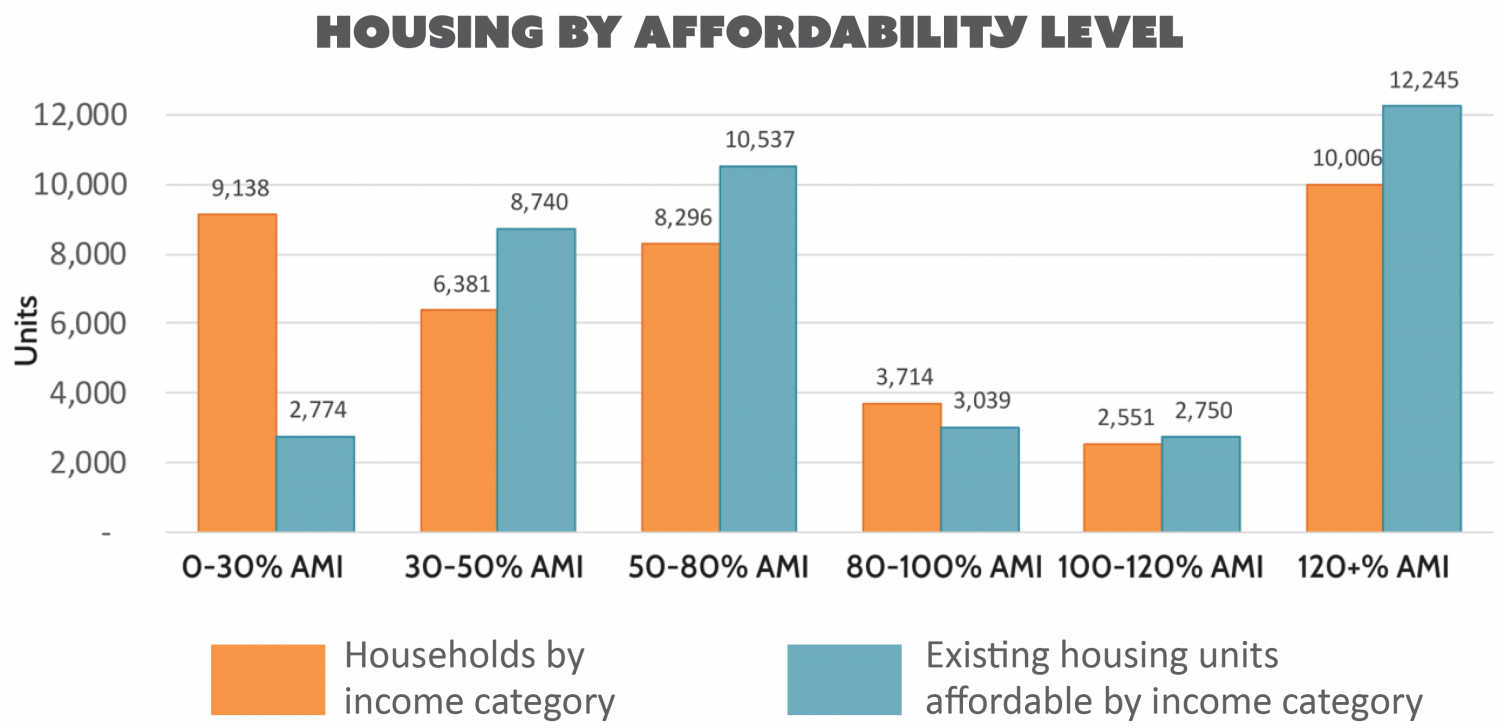
Because the households at the lower income levels often can’t find housing they can afford, they have to spend more on housing. This has a cascading effect, making less affordable housing available for everyone.
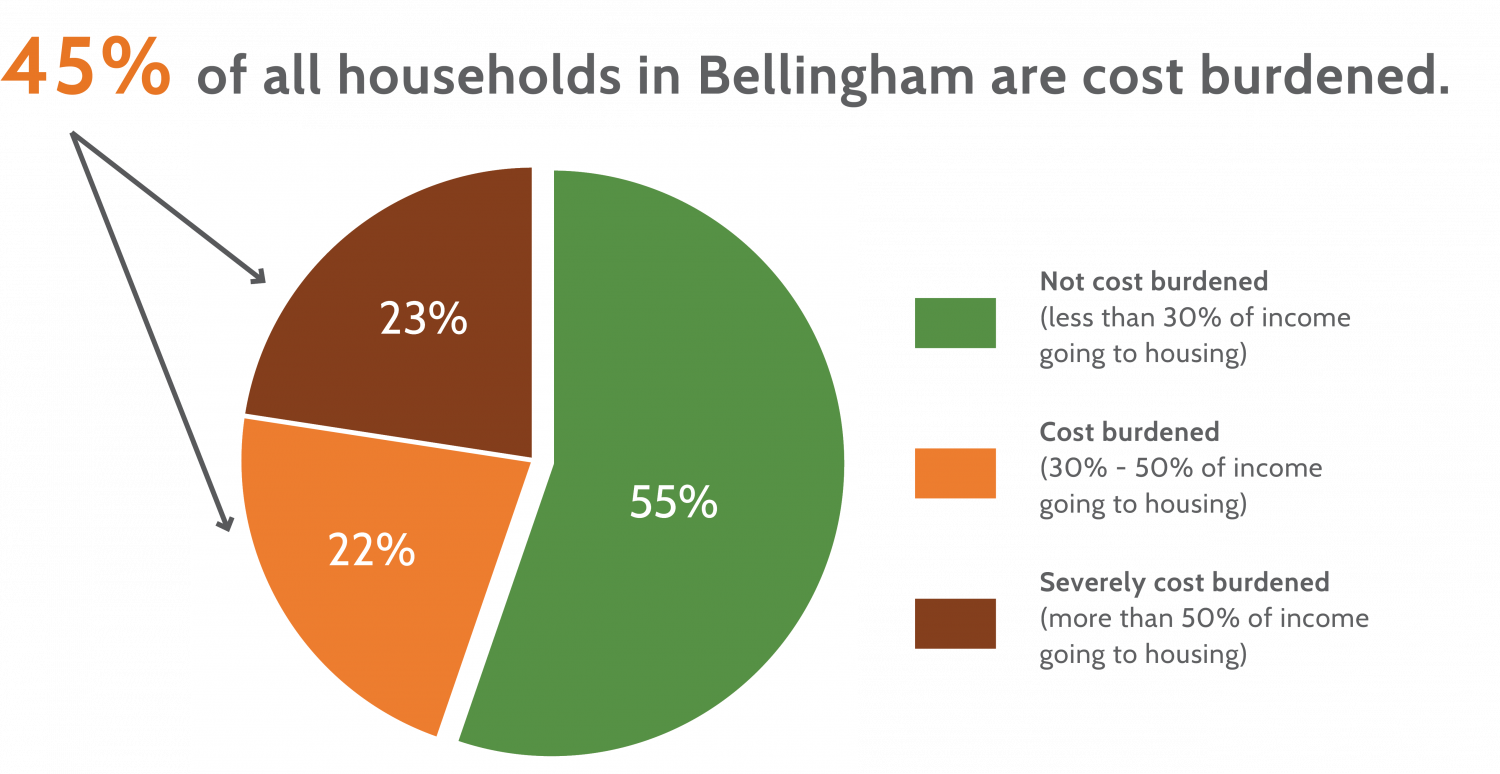
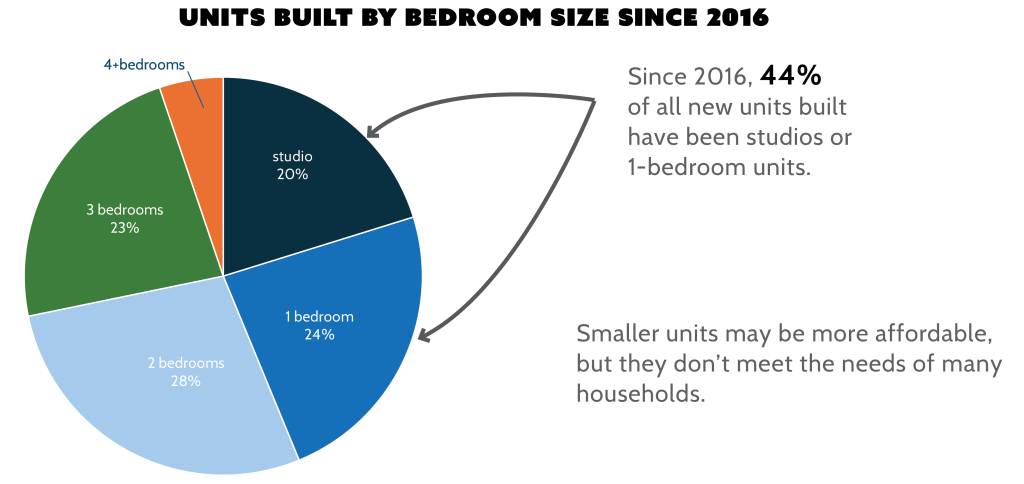
Additionally, there are gaps in the size of units desired. The City’s 2023 housing preference survey found that most people in Bellingham would prefer at least two bedrooms. However, since 2016, 44% of all new units built have been studios or 1-bedroom units.

The City of Bellingham supports a variety of critical human service programs and housing projects. The City’s main role in these programs is as a funder. Using local, state, and federal funds, the City partners with many government and non-profit agencies who are working to address the spectrum of community needs through prevention, crisis response, and stability. View our storymap below to learn more.
Housing affordability is also influenced by how protected renters are from unexpected costs, unsafe living conditions, or other unfair practices. Below are a few of the federal, state and local protections for renters.
- Federal Fair Housing Requirements – The 1968 Fair Housing Act and its amendments protect people from housing discrimination because of their: race, color, national origin, religion, sex, disability or family status (having children or being pregnant). In addition, Washington State Fair Housing laws also covers: marital status (being single, married or divorced); sexual orientation; gender identity and military / veteran status. Visit cob.org/services/housing/fair-housing to learn more.
- State Tenant Protections – While rent control is not permitted by the Washington State Constitution, there are several state-wide requirements to protect tenants from unexpected rent increases and other practices, such as:
- Just cause for evictions
- Allowing payment installments for fees and deposits
- 60-day rent increase noticing
- 120-day demolition noticing
- Prohibiting using source of income in evaluating tenants
- City of Bellingham Tenant Protections – The City of Bellingham has enacted ordinances designed to provide some protection for vulnerable renters. The primary ordinances took effect on March 12, 2018, and apply to properties located in the City of Bellingham. An additional requirement around noticing was added in 2023. This suite of protections include:
- Source of Income Protection
- 120-day Notice of Rent Increase
- 60-day Notice to Vacate
- Rental Fee Protections – In August 2025, the City adopted new regulations that list allowed rental fees, limit amounts for some rental fees, and promote fee transparency. To learn more, visit the Rental Fee Laws page.
- City of Bellingham Rental Registration Program – The City of Bellingham has a Rental Registration & Safety Inspection Program to ensure that all rental housing in Bellingham meets specific life and fire safety standards and is providing a safe place for tenants to live. To learn more, visit the Rental Registration page.
- City of Bellingham Short Term Rentals (STRs) – The City of Bellingham regulates the creation and operation of STRs (often hosted on sites like Airbnb or Vrbo). The regulations are intended to balance the economic opportunity created by STRs with the need to maintain the city’s housing supply and protect the rights and safety of owners, guests and neighbors. To learn more, visit the STR page.
- City of Bellingham Consolidated Plan – The City of Bellingham Consolidated Plan was adopted in 2023 and includes several strategies to better protect vulnerable populations and tenants. Visit the Consolidated Plan page to learn more.
Climate action can often support housing affordability.
Promote Energy Efficiency and Reduce Emissions
- Encouraging and funding the rehabilitation of existing homes can reduce operations and maintenance costs for renters and owners. Retrofitting homes can also build resiliency to climate change by improving insulation to reduce heating costs, adding cooling measures for heat events, and upgrading air filtration systems to improve indoor air quality due to wildfire smoke.
- Providing homeowners with information on energy efficiency project costs, projected cost savings, and the availability of rebates, incentives and other supportive funding programs will help homeowners make informed decisions.
- Replacing gas heating with electric heat pumps will reduce emissions and provide cooling as well as heating functions year round.
Reduce Urban Sprawl
- Urban sprawl drives many challenges facing cities, including greenhouse gas emissions, air pollution, road congestion, and lack of affordable housing (OECD Report). It also increases the per-user costs of providing public services such as water, energy, sanitation, and public transport.
- Researchers at the University of California, Berkeley, found that for the 700 cities they studied, “infill housing — that is, homes built in existing urban areas, near transit, jobs and services — can reduce greenhouse gas pollution more effectively than any other option.” (Seattle Times)
- Cities can regulate development to allow for affordable and climate-friendly housing: denser housing, revised parking requirements, taller buildings, and transit-oriented development close to jobs and services.
Preserve Existing Housing
- The greenest building is the one already built: “Building reuse almost always yields fewer environmental impacts than new construction when comparing buildings of similar size and functionality.” – The Greenest Building – NTHP
- Marginalized groups are disproportionately cost burdened and more vulnerable to the effects of climate change (such as air pollution and climate disruption).
- Extreme weather events due to climate change can reduce the supply of affordable housing.
Reduced Parking Standards
- A more compact city built for people, not cars, makes it easier to choose alternative transportation (walk, bike, or bus) and prevents sprawl.
- Reduced parking supports compact growth, which reduces the cost of development and supports more affordable housing.