The City of Bellingham seeks to increase electric vehicle (EV) use City-wide as part of its commitment to address climate change.
EV Charging Locations
There are many publicly accessible charging stations throughout Bellingham located on City-owned property and adjacent to businesses. City-owned charging stations are operated by ChargePoint.
The City recently installed 45 EV chargers at 26 sites throughout Bellingham as part of its Electrification of Transportation project.
Rates at City-Owned EV Charging Stations
EV charging rates may vary depending on the station. EV charging stations installed by the City of Bellingham have the following fees:
- Energy fee of $0.25 per kWh while charging for level 2
- Energy fee of $0.40 per kWh while charging for DC level 3
- Charge of $0.25 per minute for occupying parking space after vehicle charging is complete, not to exceed $23.00, to allow for equitable access to EV charging stations
- Additional fee of $1.00 per session when using DC Fast Charger (Level 3). App service fees may apply.
Paid Parking: Paid parking rates apply to EV parking spaces located in Pay to Park lots and metered parking hours during enforcement hours. Parking fees must be paid separately through pay stations or the PayByPhone mobile app.
Residential EV charging “over the sidewalk”
A growing number of Bellingham residents drive, or are interested in driving, an electric vehicle (EV). They may struggle to find reliable charging solutions if their homes have no dedicated, off-street parking. We are working to increase EV charging access to help meet our climate action, vehicle electrification, and affordability goals. To assist you, we provide guidance for on-street Level 1 (110-120V) charging in single-family and multi-family zones that are located on non-arterial (residential/secondary) streets. ADA-compliant cable covers are required in the City of Bellingham for charging over the sidewalk. Households with incomes at 80% AMI or lower may be entitled to a rebate for an eligible ADA-compliant cable cover. Please see the guidance and rebate documents below for more information.
EV charging cord guidance for crossing the public right-of-way (ground-floor, residential use)
By following this guide, a Public Works Right-of-Way permit is not required to charge an EV on the street. If you have off-street parking available, you must use that parking spot for charging rather than parking on the street. This guidance applies to ground-floor residential uses in single-family and multi-family zones. We have developed this guidance for properties with an adjacent sidewalk. This guide is provided based on current circumstances and is subject to change.
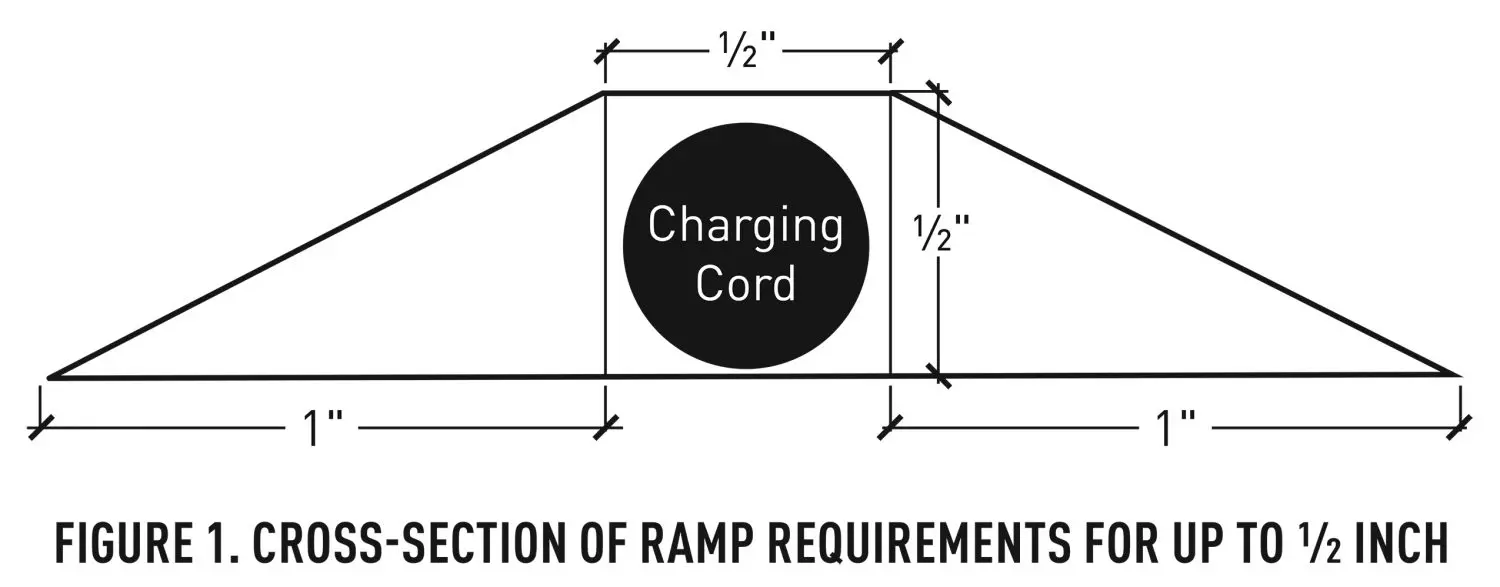
Charging cables must be covered by a highly visible, stable, and secure ADA-compliant cable protector while charging. The following cable protector requirements apply:
- The cable protector will be listed as “ADA-compliant”;
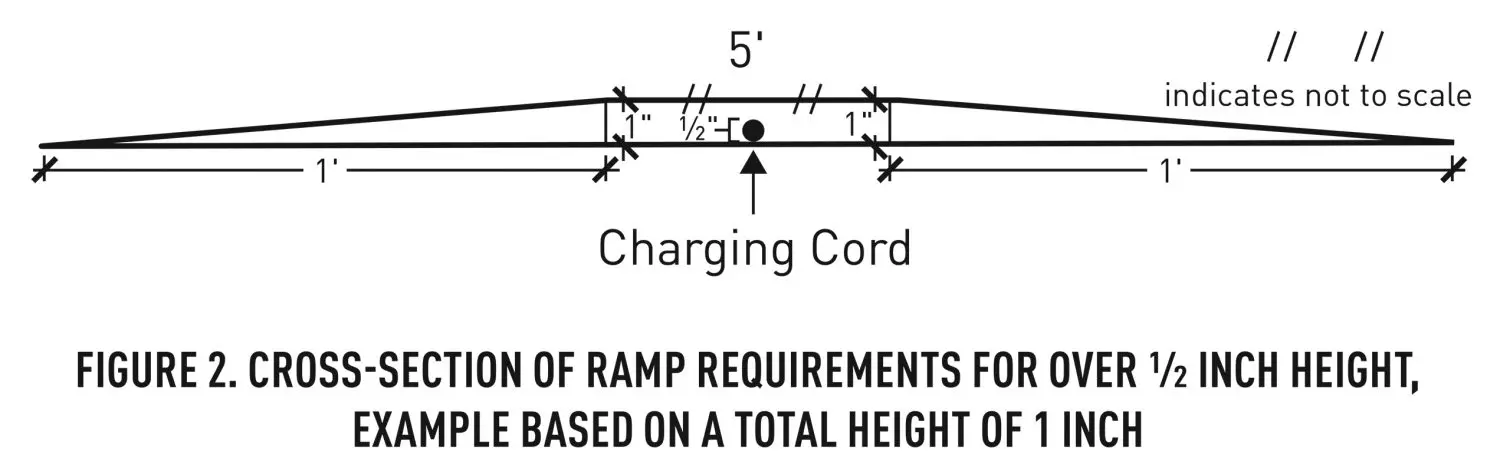
- The cable protector shall be no steeper than an 8.3% grade or 1:12 gradient;
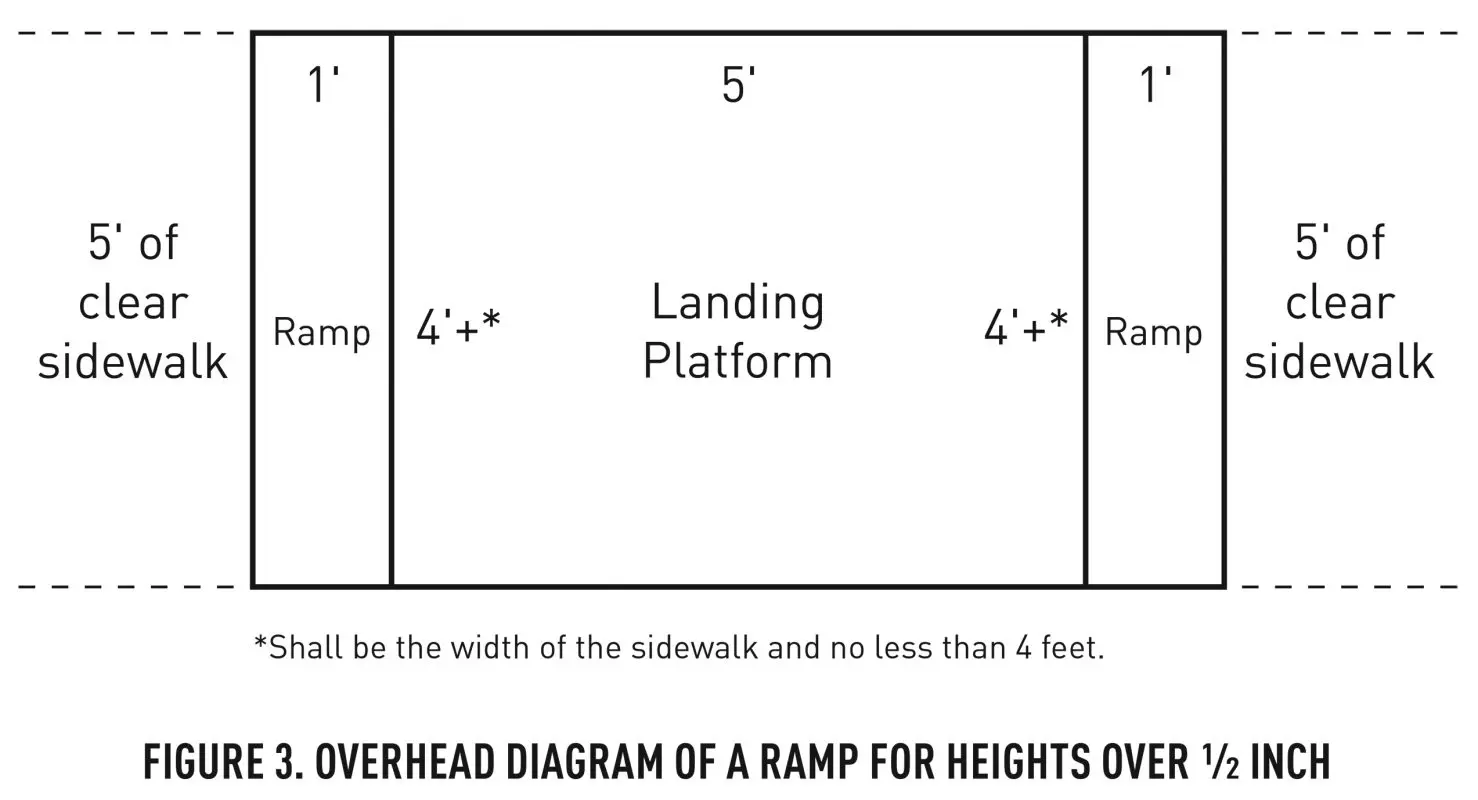
- The cable protector shall cover the entire width of the sidewalk and can be no less than 4 feet wide;
- A cable protector assembly may be composed of individual cable protector sections that link securely to make a wider ramp;
Cable protectors must meet or exceed the requirements above.
Please note: Most cable covers on the market are not ADA-compliant and do not meet the specifications above. A cable cover that does not meet the requirements is considered a hazard for pedestrians and can be removed by the City of Bellingham, along with any associated charging equipment.
Example cable protectors that meet the guidelines above include:
- “5 Channel Rubber Cable Protector Ramp, ADA Compliant Low Profile Drive Over Cable Protector” by WKINGBOOM
- “45 in. x 31.5 in. Cable Protector Ramp 3.75 ft. 22000 lbs. Load Raceway Cord Cover Conduit ADA Compliant 5 Channel” by SKYSHALO
- “ATLAS® ADA Cable Protector Ramp” by ATLAS
- “5 Channel Cable Protector Ramp 22000lbs Load ADA Compliant Wire Cable Cover” by LOVMOR
When purchasing a cable protector, it is advised that you check the size of the channel (where the cable will lie) to ensure that it will accommodate the diameter of your charging cable.
Cable protectors must be placed correctly on the sidewalk to avoid creating accessibility challenges.
- The EV charging cord and cable protector must cross perpendicular to the sidewalk to reduce mobility barriers;
- A 3-
- The landing must be flat, with no more than a 2% slope (1:50 gradient) in any direction; and
- Perpendicular to the direction of travel, the cable protector cannot have a cross slope exceeding a 2% grade (1:50 gradient).
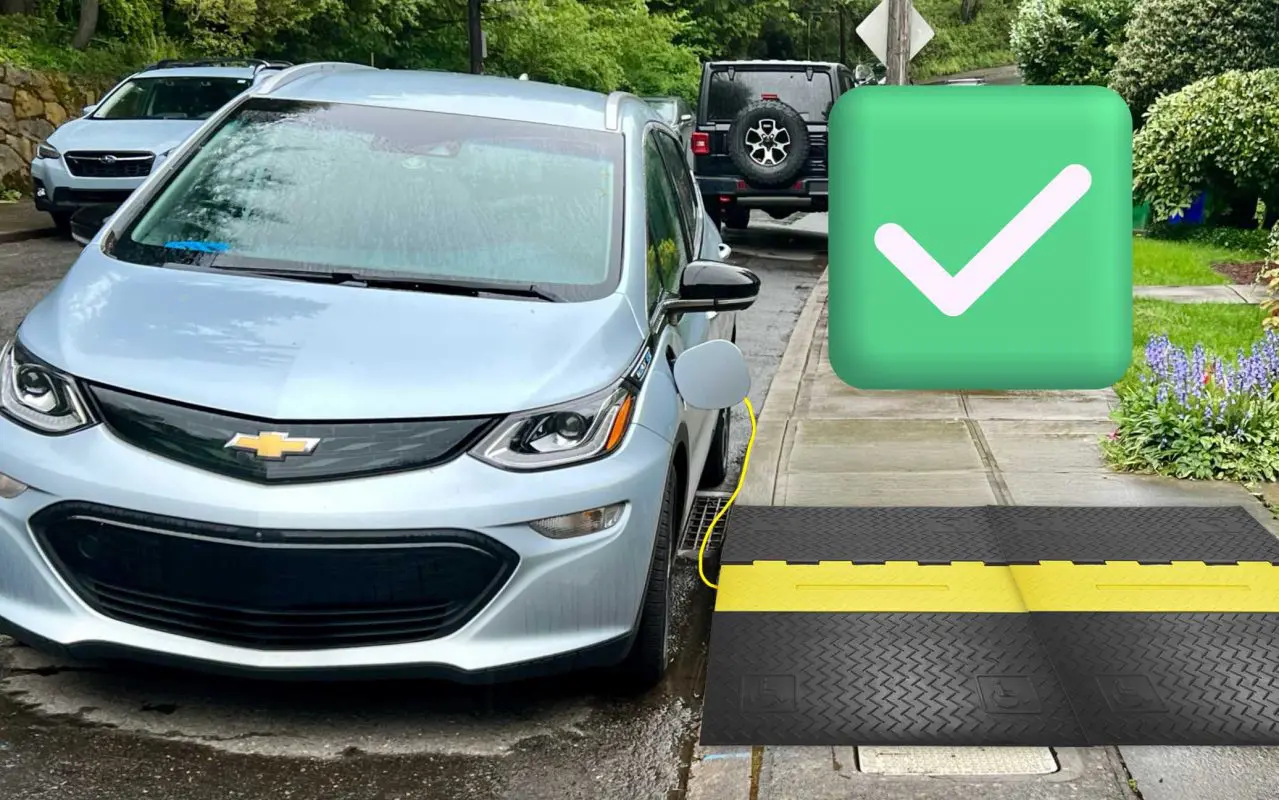
The right way
The cable protector meets requirements and extends the entire width of the sidewalk.
(Photo credit: Jonathan Maus/BikePortland)
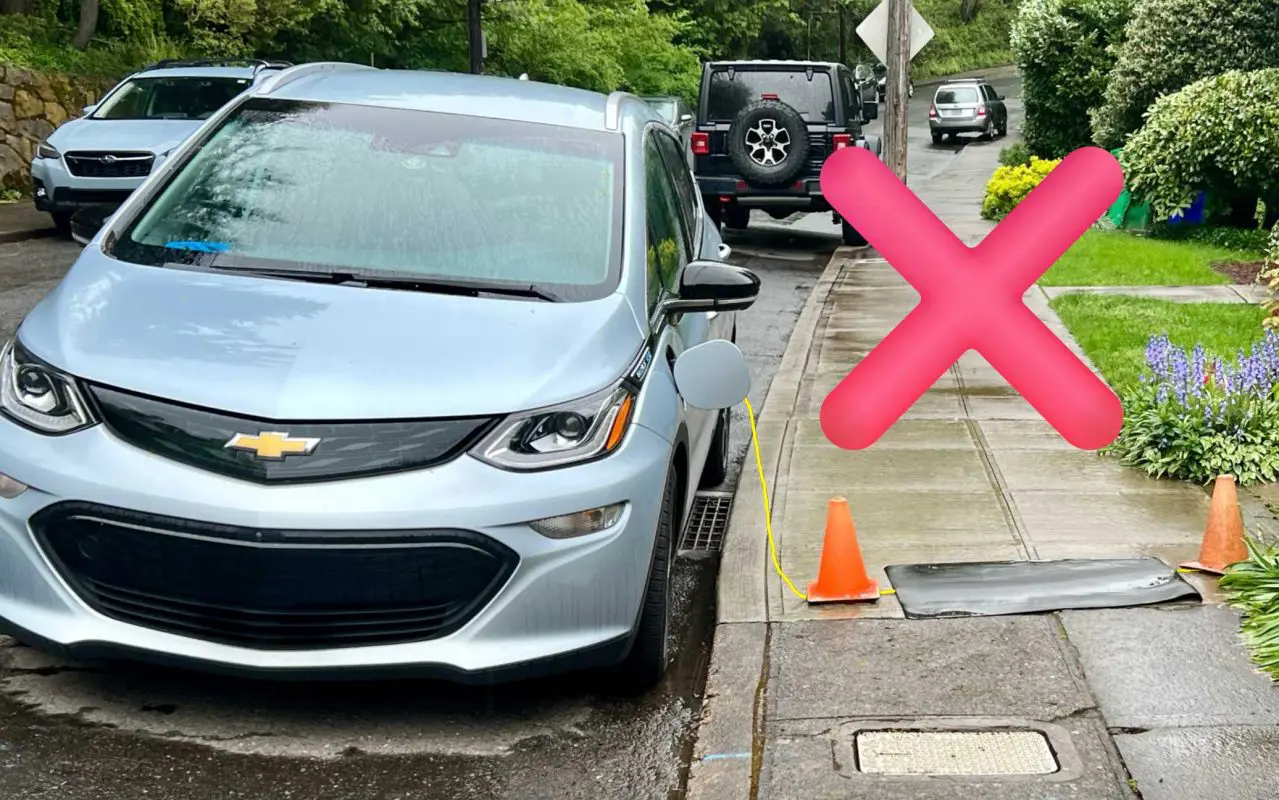
The wrong way
The cable protector does not meet requirements and does not extend the entire width of the sidewalk.
(Photo credit: Jonathan Maus/BikePortland)
- All receptacles utilized for the connection of electric vehicle charging shall have ground-fault circuit-interrupter protection for personnel.
- Use only Level 1 (110-120V) voltage for charging equipment. No Level 2 (240V) voltage may cross the public right-of-way.
- Power supply cords must be listed for outdoor use, of the appropriate gauge for the intended use, and in an undamaged condition.
- When not charging an EV, all charging equipment must be removed from the sidewalk within right-of-way. The cable cover itself may remain in place.
- You are responsible for complying with all relevant sections of the National Electric Code. Please note that electrical permits are required for new outlets.
- You are not guaranteed a reserved parking space for charging your electric vehicle on public streets. You cannot use signage or other means to reserve the parking space in front of your residence.
- All local parking regulations, both temporary and permanent, remain unchanged. City parking regulations prohibit parking against the direction of traffic to make it easier to charge your car, or otherwise. Please see Bellingham Municipal Code 11.33.070 Additional parking regulations (RCW 46.61.575).
- Use an outlet linked to your utility bill.
Interested in an EV?
These resources may be helpful if you are considering going electric:
- Puget Sound Energy’s (PSE) Up & Go Electric program
- Department of Energy Alternative Fuels Data Center
Climate Action Goals
The transportation sector is the largest source of greenhouse gas emissions in Bellingham, accounting for approximately 43% of community emissions. The Council-adopted 2018 Climate Action Plan (CAP) and subsequent 2022 Climate Implementation Plan both prioritize increasing electric vehicles and charging infrastructure to reduce emissions from transportation. The measures in these Plans call for equitably advancing electrification of transportation across Bellingham and promoting a shift from internal combustion engines to large-scale adoption of EVs.
The City’s goal is to have 40% of all vehicles be electric by 2030 as stated in the CAP. Learn more about Bellingham’s climate action goals.
