This project will renew existing infrastructure at Post Point, strengthening the treatment plant’s ability to protect the environment and remove contaminants from the community’s wastewater. Every day, we process and treat wastewater to safeguard local waterways, marine ecosystems, and public health. Our plant exists solely to reduce pollution in wastewater generated by the community, and this investment will enhance our ability to fulfill that mission for decades to come.
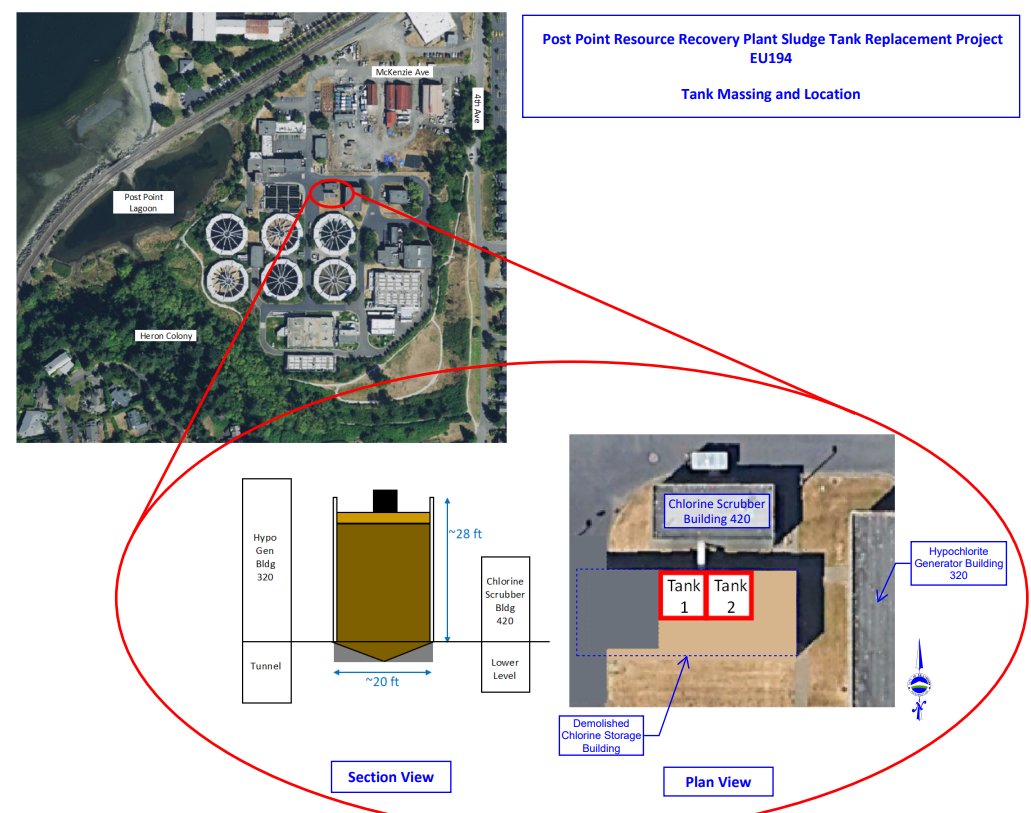
Additionally, the Post Point Sludge Tank Replacement Project (EU194) will repurpose the Chlorine Scrubber Building, converting this vacant plant building to receive a new pumping system. Odor control systems will be installed for the sludge tank to ensure nuisance odors are controlled. Several essential pumping and piping elements inside the plant will also be upgraded, including the Waste Activated Sludge pumps, sections of Return Activated Sludge piping and pumps, and the Thickened Sludge pump systems. These are all crucial pieces of infrastructure for the facility’s pollution-reduction efforts.
The sludge storage tanks—both the old steel tank being removed and the new concrete tank being built—are key components of Post Point’s Wastewater Solids Management system. These tanks help regulate and homogenize the daily inflow of solids extracted from the community’s wastewater, ensuring effective operations of the downstream dewatering and incineration processes.
Project Status – Spring 2026
Project Design and Permitting began in 2023, and the design phase is nearly complete. Project permitting is underway, and we expect to advertise the project for construction bids in late 2026.

Learn more
This project is part of the City’s 1% for Art Program (BMC 4.92), with funding supporting art to be installed near the Lower Padden trail entrances. It is proposed that the art will celebrate the unique natural beauty of the adjacent Post Point Lagoon and its thriving heron colony, reflecting the plant’s commitment to environmental preservation.
Construction for this project will take place entirely within the fenced perimeter of the Post Point Resource Recovery Plant at 200 McKenzie Avenue, ensuring minimal disruption to the surrounding community. No impacts to street traffic or public access are anticipated. However, residents can expect increased truck activity and construction personnel parking around the treatment plant from spring 2026 through 2027 while upgrades are completed.
The existing steel sludge storage tank has reached the end of its service life and is now used infrequently and only when necessary to store sludge. Over time, exposure to the corrosive nature of sewage sludge has compromised the tank’s coating and structural integrity, making continued use unsustainable. Removing this tank from general service has required adjustments to the solids handling process and has reduced redundancy in delivering solids to the incineration system. Replacing the tank will restore reliability, improve process resilience, and ensure a consistent, uniform flow of treated solids to dewatering and incineration.
Before 2022, the City invested several years in studying and planning the replacement of the plant’s incineration process with anaerobic digesters and land application—an alternative approach to solids management. Anaerobic digesters rely on bacteria to break down sewage sludge into biosolids, a compost-like material. As part of the proposed biosolids project, the steel sludge storage tank and the overall solids handling process were slated for decommissioning or replacement.
Unfortunately, anaerobic digestion does not break down certain toxic contaminants which may be present in wastewater, including Contaminants of Emerging Concern like plastics, fire retardants, PFAS (Per- and PolyFluoroAlkyl substances) and PCBs (PolyChlorinated Biphenyls). Throughout the planning process, the City became increasingly concerned with the prospect of land applying biosolids containing Contaminants of Emerging Concern. The cost of the biosolids project was another significant concern, with estimates ranging from $200 million to $1 billion.
In September 2022, after careful evaluation, the City decided to discontinue plans for anaerobic digestion and instead refocus on repairing, rehabilitating, and upgrading the plant’s existing sewage sludge incinerators. The Sludge Tank Replacement project directly stems from that decision, ensuring the plant continues to effectively remove contaminants, protect local waterways, and serve the community’s environmental needs well into the future.
The total project cost is estimated at $19,500,000 inclusive of Design, Permitting, Construction Contract and Construction Management costs. This project is funded by the City of Bellingham Sewer Fund.
- Project design start date: June 2023
- Contract Award Date: Not Complete
- Expected Construction Start Date: 2nd quarter 2026
- Dates of expected construction impacts: Spring 2026 through 2027
- Expected construction end date: Late 2027
Contact
General project questions: AskPW@cob.org
Media inquiries: Email pwmedia@cob.org
Project Manager
Stephen Day, Plants Engineer
Phone: (360) 778-7944
Email: smday@cob.org
