Project Overview
The Squalicum Creek Estuary Restoration Project builds on prior planning work to address three fish passage barriers and restore the degraded estuary at the mouth of Squalicum Creek. This multi-benefit project helps fulfill local, state, and federal priorities for species recovery, flood risk, water quality, and climate resilience.
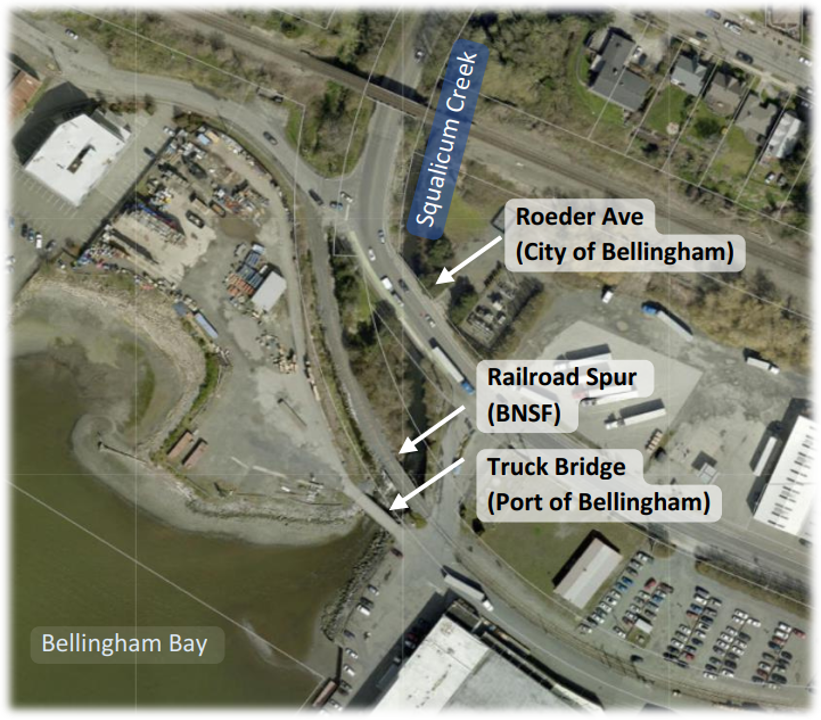
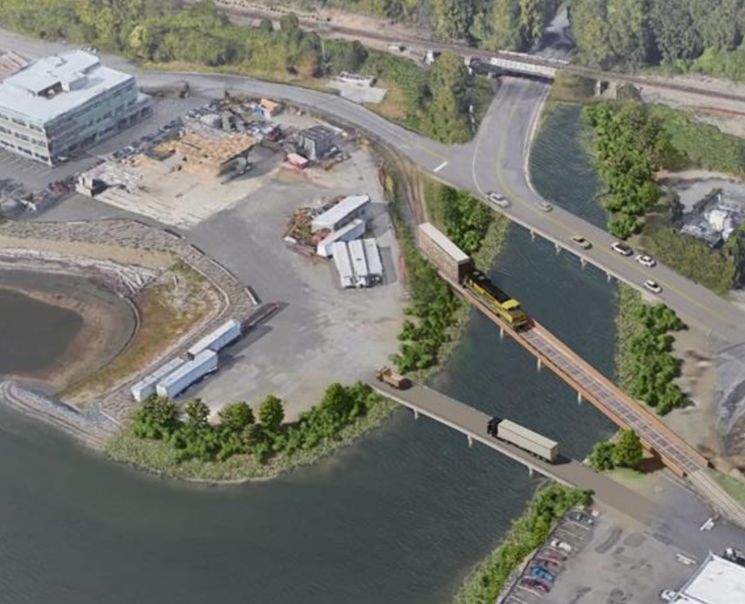
Once constructed, the project will restore full fish passage to three partial barriers in the lowermost 0.1 miles of the stream system, opening up more than 40 miles of upstream habitat. The three barriers are the City-owned Roeder Avenue culvert, the Burlington Northern Santa Fe (BNSF) Railroad-owned culvert, and the Port of Bellingham-owned bridge. Due to their close proximity to each other, the barrier removals must be designed and constructed together. The City will work in close coordination with the Port and BNSF to complete a feasibility study and alternatives analysis and advance the preferred alternative to a 60% design stage.
Project Status – Spring 2025
A request for qualifications (RFQ) for Engineering design services is expected to be published in late spring 2025 with design expected to begin in summer 2025. The RFQ will provide guidelines and expectations from the City for this federally funded design phase (up to 60% design). The project includes coordination with the City, Port of Bellingham, Burlington Northern Sante Fe (BNSF), and adjacent properties, and must address contamination surrounding the project area, challenges with railroad grades, and infrastructure. Additional funding is needed for final project design, permitting, right of way, and construction phases.
More Information
Existing conditions
Squalicum Creek is the largest independent coastal stream in the Nooksack River Basin. Today, Squalicum Creek flows to Bellingham Bay in a narrow channel near the intersection of Roeder Ave and Squalicum Parkway. The estuary is the lower portion where freshwater mixes with saltwater. There are currently three fish passage barriers under three different ownerships: Port, City, and BNSF. While historically the mouth of Squalicum Creek was a large estuary, it is now narrowed by development.
The project will restore crucial habitat for multiple anadromous Pacific salmon stocks, including juvenile Chinook salmon. This habitat has been documented as important in the Nooksack Basin for Chinook to rear prior to migrating to the Pacific Ocean (Beamer et al. 2016). The project will also benefit Southern Resident Killer Whales (orcas) who are listed as endangered under the ESA.
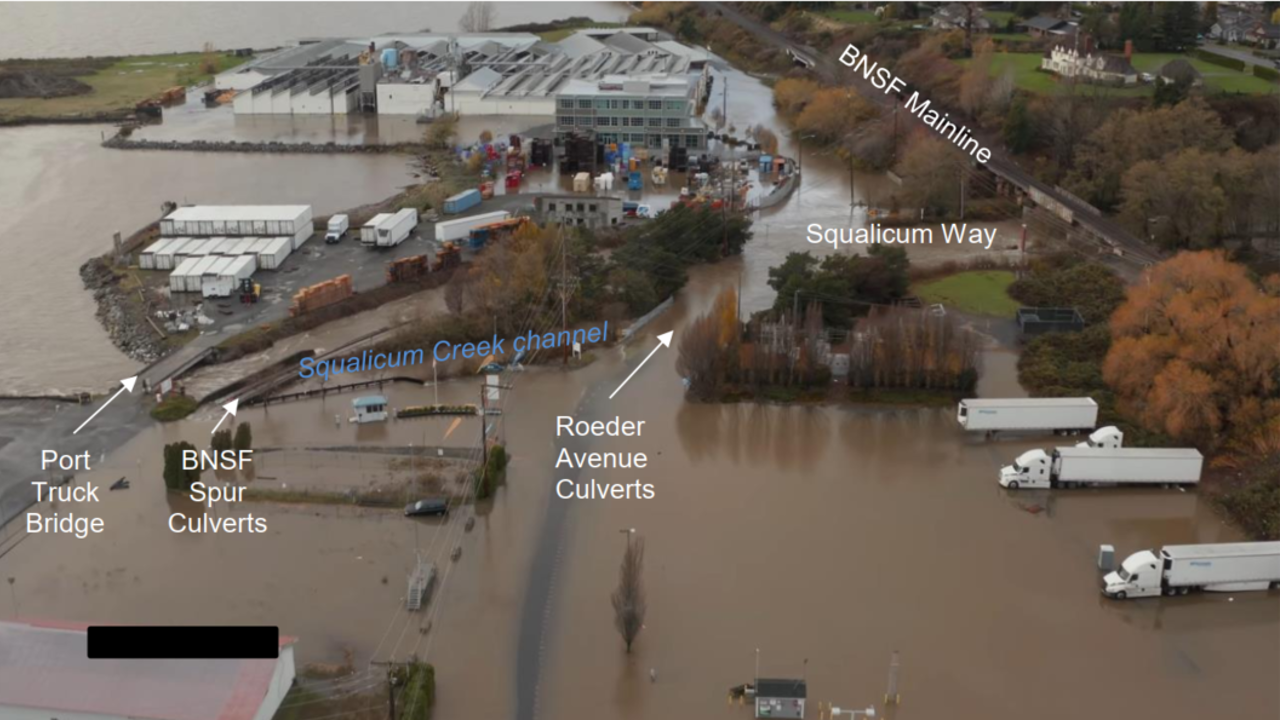
Squalicum Creek Estuary has three crossing structures in the lowermost 0.1 river miles of the system that limit fish passage to more than 40 miles of upstream habitat. All of these structures have a nexus with local transportation facilities. The Roeder Avenue structure, which carries cars and trucks across Squalicum Creek, is a three-cell concrete culvert. Immediately downstream of Roeder Avenue is the railroad spur structure, carrying a BNSF railroad facility. The railroad spur structure is comprised of six concrete box culverts and connected to Roeder Avenue by a concrete flume. The Port truck bridge is a 60-foot-long concrete slab bridge with wood footings. During high tide, water levels approach or exceed the top of the openings of the Roeder Avenue and railroad spur structures, resulting in a constriction of flow into and out of the estuary and Squalicum Creek. At low tide, the creek outflow is split among the openings and is commonly spread out and very shallow, preventing upstream fish passage during such conditions.
The area is also susceptible to annual localized flooding in the winter during storms and high tide events. The largest recent storm event was in November 2021 and is estimated to have exceeded a 100-year event (see image below).
Project benefits
This project has been prioritized through statewide assessments as a key location for fish passage improvements. By restoring full fish passage at three transportation crossings at the mouth of the stream, the project is intended to:
- Restore estuary habitat that has been lost to development; this habitat is crucial for multiple Pacific salmon species, including juvenile Chinook salmon who use the Nooksack Basin to rear prior to migrating to the Pacific Ocean
- Benefit Endangered Species Act-listed Puget Sound Chinook salmon, Puget Sound steelhead, bull trout, other salmon and trout species, nearshore fish populations, and Southern Resident Killer Whales
- Reduce localized flooding to improve water quality and reduce disruptions to economic activity and the transportation network
- Remove contamination from the project area
- Improve climate resilience at a site identified as vulnerable to impacts, including sea level rise
- Honor the City’s commitment in the Fish Barrier Culvert Remediation Project Memorandum of Agreement with Lummi Nation, Nooksack Indian Tribe, and the Washington Department of Fish and Wildlife.
The anticipated total cost for achieving 60% design is $2.3 million. The City has been awarded $1.84 million in funding from the federal Culvert Aquatic Organism Passage (AOP) Program through Washington State Department of Transportation Local Programs. The Washington State Department of Ecology’s Toxics Cleanup Program is providing an additional $300,000. The City of Bellingham and Port of Bellingham will split the remaining project cost of $160,000.
Building on prior investments
The Squalicum Creek Estuary Restoration Project is supported by decades of upstream and downstream restoration. For the past 20 years, the City has completed upstream habitat and fish passage improvements in the Squalicum Creek watershed to enhance, protect, and restore anadromous fish stocks that use the creek.
The Washington Department of Natural Resources and Port of Bellingham have also made significant contributions to the restoration of downstream estuarine and nearshore habitat associated with the Squalicum Creek Estuary. Learn more below.
- 2014: Phase 1 completed by the Port of Bellingham to improve shallow salmon habitat and remove a 15,500 linear-foot pier, derelict bulkheads, pilings, and other debris to create 2.5 acres of estuarine habitat, including a pocket beach. Funded by the Washington Department of Ecology.
- 2014: Preliminary design by Port of Bellingham in collaboration with the City of Bellingham, funded by the Washington Department of Ecology.
- 2015 and 2020: The City constructed the four-phase Squalicum Creek Re-Route Project upstream of the Squalicum Creek Estuary. This project improved approximately 1.5 miles of stream channel and eliminated three fish passage barriers to increase fish access to 22 miles of upstream habitat. Phase 4 of the project also included a new bridge culvert. Phases 1 and 2 were completed in 2015, while Phases 3 and 4 were completed in 2020.
- 2019–2022: BNSF along with state, federal, tribal, and local entities collaborated on inventory and prioritization work that identified Squalicum Creek Estuary as a top priority in the Puget Sound. A Regional Conceptual Design was then created for the BNSF crossing led by Environmental Science Associates and Tulalip Tribes, funded by the Habitat Strategic Initiative Lead grants using U.S. Environmental Protection Agency funding through the National Estuary Program.
- 2024: Nooksack Indian Tribe, Lummi Nation, Washington Department of Fish and Wildlife, and the City prioritized the Squalicum Creek Estuary as the #1 City-owned fish passage barrier.
- 2024–2025: City of Bellingham is constructing the Roeder Avenue Lift Station. This project will allow for relocation of a sewer line in preparation for Squalicum Creek Estuary restoration.
- Squalicum Creek Estuary Restoration Project Fact Sheet (PDF)
- Restoration Planning at Puget Sound Coastal Streams Impacted by the Railroad – Project by Tulalip Tribes
- Port of Bellingham Squalicum Creek Estuary, Phase 1 (outer waterway restoration) JARPA Figures
- Historic Photo of Squalicum Creek Estuary from Whatcom Museum (circa 1922)
Contact
General project questions: AskPW@cob.org
Media inquiries: pwmedia@cob.org
Project Engineer
Aric Smathers, PE
Phone: (360) 778-7942
Email: arsmathers@cob.org
Habitat Lead
Analiese Burns, Habitat & Restoration Manager
Phone: (360) 778-7968
Email: acburns@cob.org
