Overview
As the national “Complete Streets” movement emerged in the early 2000s, Bellingham expanded its citywide transportation planning focus to include multiple modes, with mode-shift goals, policies, and projects for pedestrians, bicyclists, transit riders, and vehicle drivers on all arterial streets. Over the past 20+ years, Bellingham has infused the complete street ethic into all transportation plans, goals, policies, and projects.
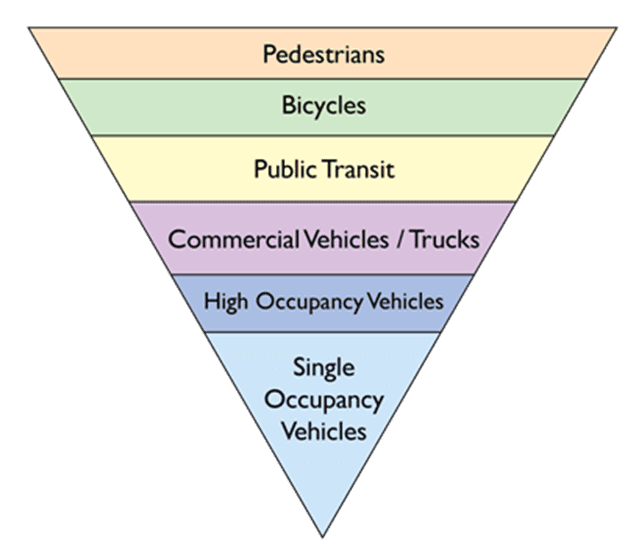
Bellingham’s Complete Network Ordinance (Ordinance 2016-09-032) formalizes this commitment, complies with Washington State’s Complete Streets legislation (RCW 47.04.320), and requires Mayoral approval for any deviation or exemption from Bellingham’s Complete Network Policies. When designing multimodal transportation improvements, Bellingham transportation planners and engineers are required to consider how to balance the safety and mobility needs of all user groups, with a priority emphasis placed on the most vulnerable user groups, as illustrated below.
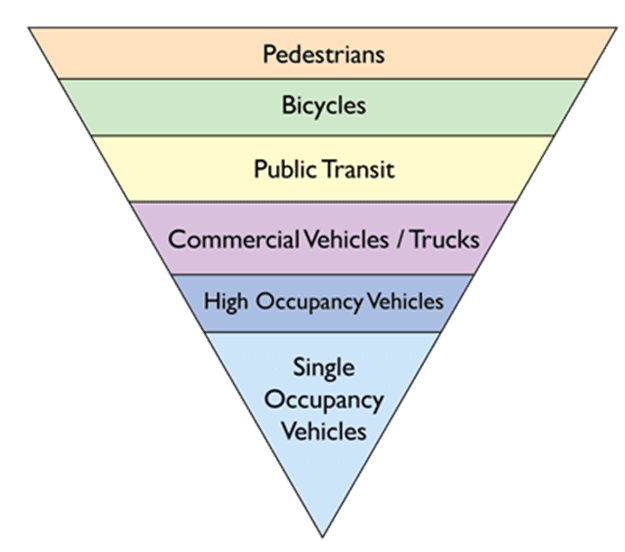
Bellingham Transportation Modal Hierarchy